
Recently elected to the U.S. Senate, Ed Markey (D-MA) has watchdogged the nuclear industry for four decades while serving in the U.S. House of Representatives. Today, he has spokean out against NRC weakening its rules on foreign ownership of U.S. atomi…
Continue readingAs reported by the Asahi Shimbun, the Japanese national government’s Nuclear Regulation Authority (NRA) is doubtful that Tokyo Electric Power Company’s (TEPCO) plan to construct underground walls will succeed in blocking the flow of radioactively conta…
Continue readingAs reported by the Asahi Shimbun:
‘TAMURA, Fukushima Prefecture—When the sun set on Aug. 1, Hisao Watanabe sat under the fluorescent lights of his living room in the Miyakoji district here and could not contain his joy.
“I don’t nee…
Map by Asahi ShimbunAs reported by the Asahi Shimbun:
“Radioactive cesium levels were much higher in water deep underground at the crippled Fukushima No. 1 nuclear plant than in samples taken closer to the surface, Tokyo Electric Power Co. said…
Dr. Gordon Thompson, executive director of the Institute for Resource and Security Studies in Cambridge, MAYesterday, to meet the U.S. Nuclear Regulatory Commission’s (NRC) arbitrarily short 30-day deadline for public comments on its “Draft Consequence…
Continue readingContact: Jennifer Rennicks, Director of Policy & Communications, 865.235.1448, jennifer@cleanenergy.org
St. Petersburg, Fla.///NEWS STATEMENT/// Duke Energy Florida (DEF) today filed a motion with the Florida Public Service Commission to approve a…
Washington, D.C.-based attorney, Diane Curran, represented environmental interveners NIRS and Ecology Party of Florida against the now-cancelled proposed new reactors at Levy Co., FLThe Ecology Party of Florida and NIRS, environmental interveners again…
Continue readingMark Cooper of Vermont Law School’s Institute for Energy and the EnvironmentEnergy economist Mark Cooper at Vermont Law School’s Institute for Energy and the Environment has issued a media statement in response to Duke/Progess’s announced abandonment o…
Continue readingMAURICE RIVENBARK | Times The crippled nuclear power plant in Crystal River [photo, above] will not be replaced with a new nuclear facility in Levy County, state Rep. Mike Fasano said Thursday.—Tampa Bay TimesAs reported by the Tampa Bay Times, Flo…
Continue readingvia Japan Times / August 1st, 2013 / Tokyo Electric Power Co. reported Wednesday a group net profit of ¥437.93 billion for the April-June quarter, but fuel costs for thermal power generation to make up for the loss of atomic energy due to the Fukushima No. 1 nuclear plant catastrophe that started in 2011 continued to weigh heavily on the utility. The quarterly net profit compares with a loss of … Continue reading →
Continue readingNRC file photo of Callaway atomic reactorAs reported by KMOV TV-4 St. Louis, Ameren’s Callaway atomic reactor, located in Fulton, Missouri, 90 miles west and upwind of St. Louis, remains shutdown, following a fire. Beyond Nuclear board member Kay Dr…
Continue readingVY’s infamous 2007 cooling tower collapse. The photo was distributed by a whistleblower.As reported by the Vermont Digger, State of Vermont Department of Public Service officials have written the U.S. Nuclear Regulatory Commission (NRC), objecting to a…
Continue readingNRC file photo of Calvert Cliffs nuclear power plant on the shoreline of the Chesapeake Bay in Lusby, MDAs reported by the Baltimore Sun, Exelon/Constellation Nuclear will pay Electricite de France (EDF) a $400 million “special dividend” payment, in ex…
Continue readingMap showing location of Entergy’s “dirty dozen” atomic reactors across the U.S.In an article entitled “Vermont Yankee to cut about 30 jobs: Critics argue loss of work force could pose operation hazards,” the Burlington Free Press reports that nationwid…
Continue reading
Sarnia Mayor Mike BradleyAs reported by the Sarnia Observer, the Mayor of Sarnia, Ontario, Canada, Mike Bradley (photo, left), has declared victory in a years-long campaign to block the shipment of radioactive steam generators, by boat on the Gr…
via RT.com / July 29, 2013 / Water samples taken at an underground passage below the Fukushima Daiichi nuclear power plant contain alarming levels of radiation which are comparable to those taken immediately after the catastrophe. According to a Saturday statement by Tokyo Electric Power Company (TEPCO), the tested water contains 2.35 billion becquerels of cesium per liter, and the radioactive water is now seeping into the sea. The findings … Continue reading →
Continue reading Every week hundred’s of nuclear news stories are published around the world that the main stream media ignores on purpose. The Radiation Bulletin shows you a mix of the top stories plus extended coverage from Fukushima to the Nuclear Fuel Cycle.
Radiation Bulletin is published by the Abalone Alliance Clearinghouse
Continue readingThe Mobile Chernobyl mock nuke waste cask, a full size replica of a truck shipping container, shown in front of the State Capitol in Jefferson City, MO during a cross-country educational tourAt 2:30 PM Eastern on Tuesday, July 30th, in room 366 of the …
Continue readingvia NHK World / July 24, 2013 / Experts estimate that cleaning up radioactivity in Fukushima Prefecture would cost 50 billion dollars, more than 4 times the amount that has been earmarked. Experts from the National Institute of Advanced Industrial Science and Technology studied the cost of decontamination for the Fukushima Daiichi nuclear accident. They estimate that decontamination in no-entry zones will cost up to 20 billion dollars, and in … Continue reading →
Continue readingvia AlJazeera.com / July 23, 2013 / The operator of Japan’s stricken Fukushima nuclear power plant has said contaminated ground water had likely been flowing into the sea, acknowledging such a leakage for the first time. Tokyo Electric Power Co, or Tepco, also came under fire on Monday for the revelation that the number of plant workers with thyroid radiation exposure times exceeding the threshold levels for increased cancer risks … Continue reading →
Continue readingTune in here, For a LIVE Presentation By Ace Hoffman on The Physics of Spent Fuel.Where else in society do we say, “Lets worry about the waste later” Learn what is next for the nuclear waste site formerly known as the San Onofre Nuclear…
Continue readingEvery week hundred’s of nuclear news stories are published around the world that the main stream media ignores on purpose. The Radiation Bulletin shows you a mix of the top stories plus extended coverage from Fukushima to the Nuclear Fuel Cycle.
Radiation Bulletin is published by the Abalone Alliance Clearinghouse
Continue readingvia Wall Street Journal / July 22, 2013 / Media surveys ahead of Sunday’s upper house election show that Japanese voters are placing the economy above all other issues, including the future of nuclear energy use. That appears to be true even in the prefecture of Fukushima, home to the 2011 disaster at the Fukushima Daiichi nuclear plant that was the country’s worst-ever nuclear accident. The Liberal Democratic Party … Continue reading →
Continue readingvia Times Of India / July 22, 2013 / The ongoing saga of Fukushima nuclear plant in Japan that suffered a triple meltdown in March 2011 just got dangerously murkier. The number of workers who suffered cancer-inducing radiation doses is not 178, but 1,978, Asahi Shimbun reported on Friday. That’s eleven times more than admitted by Tepco, the owner of the plant last December. After much international pressure, Tepco had … Continue reading →
Continue readingToledo attorney Terry Lodge represents the environmental coalition. Here he speaks out against Davis-Besse’s 20-year license extension at an NRC hearing held at Oak Harbor High School in August 2012DAVIS-BESSE HEARING DOCKET: Click here to link to all …
Continue readingVermont Yankee cooling tower collapse, 2007As reported by Andrew Stein at the Vermont Digger, Entergy Nuclear is forcing its Vermont Yankee workforce of 650 to essentially re-apply for their own jobs, with indications to up to 10% could be let go as a …
Continue readingPalisades and Davis-Besse are amongst the oldest, most risky, and most likely to permanently shutdown in the near-term of the three dozen atomic reactors located on the U.S. and Canadian shores of the Great Lakes (link to a copy of this map in the text…
Continue readingMark Cooper, Vermont Law SchoolIn a new report, Renaissance in Reverse: Competition Pushes Aging U.S. Nuclear Reactors to the Brink of Economic Abandonment, Vermont Law School energy economist Mark Cooper (photo, left) of Vermont Law School has identif…
Continue readingThe newly published World Nuclear Industry Status Report 2013 (WNISR) provides a reality check of the current situation and trends of an industry in great difficulties. Nuclear power generation experienced a record drop of 7 percent in 2012. …
Continue readingvia ZeroHedge.com / Several companies applied to Japan’s Nuclear Regulation Authority on July 8 for permission to restart a total of 10 nuclear reactors in the country. Despite widespread apprehension in Japan about nuclear power following the Fukushima disaster in 2011 that led to the shutdown of all of the country’s 54 nuclear reactors, the plan to restart the reactors may succeed for a few reasons. The reactors are located … Continue reading →
Continue readingvia IntelliHub.com / Anyone who follows the alternative media knows that the nuclear fallout from Fukushima is far worse than the governments of the world and the mainstream media will admit. A series of different photos have been posted on the web, showing the kind of mutations that the fallout has caused plants in nearby areas. Recently it was also reported that radioactive water from the site has been leaking … Continue reading →
Continue readingvia SimplyInfo.org / July 17, 2013 / After months of data about water and little else, TEPCO remains mum on unit 3. Considerable progress has been made in removing the debris on the refueling floor. This reveals what could be considerable information and evidence related to the meltdown and massive blast at unit 3. The last report on unit 3 was in late May when they installed a cover over … Continue reading →
Continue reading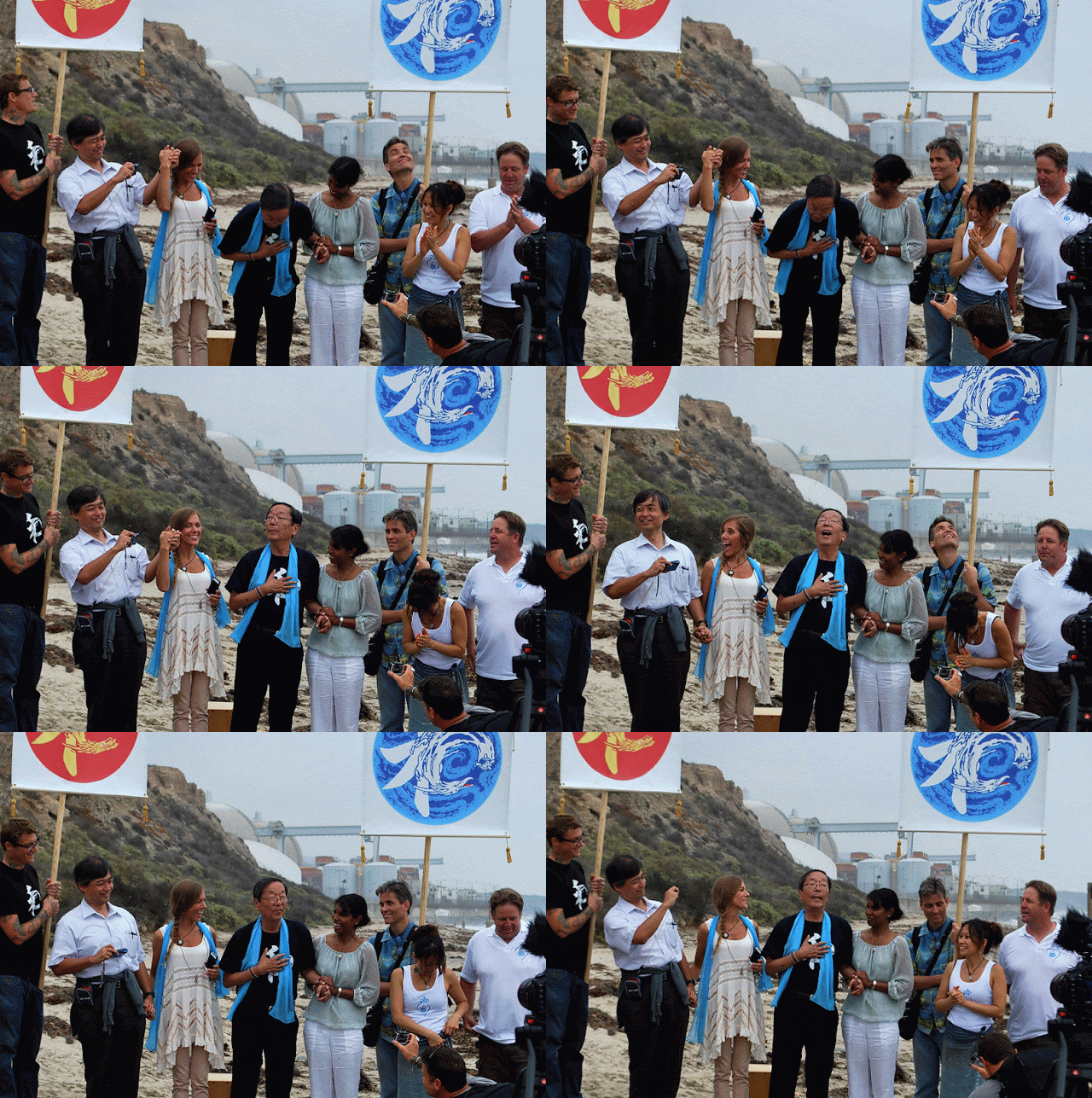
Water, I am sorry.
Water, please forgive me.
Water, I love you.
Water, thank you.
73% of the 948,956 spent fuel rods generated by The San Onofre Nukes are still stored in the plant’s two spent fuel pools.
The time has come to set our intention about how we want to safely store this waste for the next 1 million years.
Peace be with you, All My Peace,
The Peace that is ” I “, the Peace that is “I am”.
The Peace for always, now and forever and evermore.
My Peace ” I ” give to you, My Peace ” I ” leave with you,
Not the world’s Peace, but, only My Peace,
The Peace of ” I “.
Click here for the San Onofre Water Blessing Photoset
KA MALUHIA O KA “I”
O ka Maluhia no me oe, Ku’u Maluhia a pau loa,
Ka Maluhia o ka “I”, owau no ka Maluhia,
Ka Maluhia no na wa a pau, no ke’ia wa a mau a mau loa aku.
Ha’awi aku wau I ku’u Maluhia ia oe, waiho aku wau I ku’u Maluhia me oe,
A’ole ka Maluhia o ke ao aka, ka’u Maluhia wale no,
Ka Maluhia o ka “I”.
Related articles


Aging Nuke Plants On Fault Lines In Tsunami Hazard Zones = Fukushimas… Any Questions?
PLEASE Turn off a light for Fukushima USA / San Onofre
PLEASE Turn off a light for Fukushima USA / San Onofre
To the people of Japan,We, the anti-nuclear activists and environmentalists around the world, are very sorry this catastrophic nuclear accident has happened to the people in the land of Japan. We will continue to support and pray for you all….
Continue readingvia OpEdNews.com / June 15, 2013 / Situation Normal, All Fukushima’d Up The first thing to know about the danger from the radioactive mass remaining on site in the three reactors that melted down at Fukushima is that nobody knows how much radioactive material there is, nobody knows how much uranium and plutonium it contains, and nobody knows how to make it safe — so no one knows how great … Continue reading →
Continue readingvia Euronews.com / June 15, 2013 / The first phase is complete of a plan to build the world’s largest offshore wind farm near the Fukushima nuclear plant that was crippled by an earthquake and tsunami in March 2011. The first turbine has been delivered to the area and the facility is due to become operational in October. It is part of plans by Fukushima Prefecture to ditch nuclear energy … Continue reading →
Continue readingMI Radio photo showing the location of the SIRWT, located on the roof directly above the control room; the reactor containment building towers to the leftAs announced by a U.S. Nuclear Regulatory Commission (NRC) meeting notice, the agency will ho…
Continue readingTerry Lodge speaks out against Davis-Besse’s 20-year license extension at a press conference in Oak Harbor, OH, in August 2012. The main bone of contention at that time was the recently revealed severe cracking of Davis-Besse’s concrete containment str…
Continue readingOn July 11th, Thom Hartmann (photo, left) interviewed Beyond Nuclear’s Kevin Kamps on his radio show about the cancer death of Masao Yoshida, Tokyo Electric Power Company’s (Tepco) general manager of the Fukushima Daiichi nuclear power plant, and leade…
Continue readingvia QZ.com / June 12th, 2013 / Radioactive water has been steadily leaking into the sea around the damaged Fukushima Daiichi nuclear power plant ever since it was hit by an earthquake and tsunami in March 2011, Japan’s nuclear watchdog announced on Wednesday. Plant operator Tokyo Electric Power Co, widely reviled for its inept response to the disaster, had long insisted that no leakage was taking place; in recent days … Continue reading →
Continue readingvia HuffingtonPost.com / July 10th, 2013 / Masao Yoshida, the man who led the life-risking battle at Japan’s crippled nuclear power plant when it was spiraling into meltdowns, died Tuesday of cancer of the esophagus. He was 58. Tokyo Electric Power Co. spokesman Yoshimi Hitosugi said Yoshida died at a Tokyo hospital. TEPCO officials said his illness was not related to radiation exposure. Yoshida led efforts to stabilize the Fukushima … Continue reading →
Continue readingvia CommonDreams.org / July 10th, 2013 / Levels of radioactive substances have surged once again in the groundwater surrounding the crippled Fukushima nuclear power plant, the Tokyo Electric Power Co. said on Tuesday. The rates show that radioactive contamination is quickly spreading in the disaster area despite ongoing efforts to decommission the site, with levels of cesium-134 and cesium-137 as high as 90 times greater than they were just three … Continue reading →
Continue readingTerry Lodge, Toledo-based attorney, speaking out against Davis-Besse’s 20-year license extension in August 2012 at Oak Harbor High School, OHTerry Lodge (pictured left), Toledo-based attorney representing an environmental coalition intervening against …
Continue readingvia The Peninsula Online / July 8th, 2013 / Japan moved a step closer to restarting nuclear reactors yesterday as four utility companies applied for safety inspection of 10 idled plants, the clearest sign of a return to atomic energy nearly two and a half years after the Fukushima disaster. Prime Minister Shinzo Abe has pushed for restarts since taking office in December, freezing the previous government’s nuclear phase-out plan. … Continue reading →
Continue readingvia Wall Street Journal / July 8, 2013 / More than two years after the devastating accident at Japan’s Fukushima Daiichi nuclear plant, operator Tokyo Electric Power Co is seeing levels soar of a radioactive element called tritium. The problem spot is on the coastal side of the plant’s heavily damaged No. 2 reactor, one of the areas where Tepco regularly monitors groundwater to check for radioactive elements that may … Continue reading →
Continue readingEverybody is Goin Surfing Surfing USA! Recent whistle blower news from San Onofre, San Clemente Green has been told that Edison is in the process of releasing bulk chemicals into the ocean as a cost saving measure. Edison is emptying huge storage…
Continue readingCan Germany Lead California To Energy Freedom?
Germany’s Clean Energy Push: What Can the World Learn
Register Now
Live, Free Webinar*
Tue, Jul 9, 2013 11:00 AM – 12:00 PM EDT
Known as the Energiewende, or “energy transition“, Germany’s campaign to move to renewable power is ambitious, massively popular at home, and by many accounts, quite successful. With 25% of Germany’s electricity currently being sourced from solar, wind, and biomass generation and a target of 80% renewable by 2050 in place, the German energy economy is worth watching.
What can the rest of Europe, the U.S., and other nations learn from one wealthy nation’s aggressive clean energy push? Will Germany succeed in meeting its goals? Which are its biggest obstacles? And perhaps most importantly, can other nations replicate Germany’s most positive achievements? Join us as we ask:
– What distinguishes Germany in terms of economics or political will that has made energiewende possible? Which nations have similar qualities?
– What has been Germany’s most successful strategy in cleaning up its energy mix?
– Is the decision to eliminate nuclear power after the Fukushima event consistent with Germany’s goals?
– What could prevent other nations from adopting similar strategies?
Featuring:
– Rainer Baake:
Director of Agora-Energiewende, former Deputy Minister of the German Federal Environmental Ministry
– Dr. Sören Buttkereit:
Vice President of regulatory strategies for Siemens Energy, focused on market design in the power sector and the adaptations required for a successful transition towards systems with a higher share of (intermittent) renewables.
– Stephanie Wang
Regulatory Policy Director for the Clean Coalition, a nonprofit working to encourage a modern energy system of smaller-scale, efficient, renewable energy projects.
– Jesse Jenkins, Moderator:
MIT Energy Initiative Energy Fellow and Community Manager at The Energy Collective, former Director of Energy and Climate Policy at the Breakthrough Instituteenergiewende possible? Which nations have similar qualities?
What has been Germany’s most successful strategy in cleaning up its energy mix?
Is the decision to eliminate nuclear power after the Fukushima event consistent with Germany’s goals?
What could prevent other nations from adopting similar strategies?
Related articles


Aging Nuke Plants On Fault Lines In Tsunami Hazard Zones = Fukushimas… Any Questions?
PLEASE Turn off a light for Fukushima USA / San Onofre
PLEASE Turn off a light for Fukushima USA / San Onofre
Every week hundred’s of nuclear news stories are published around the world that the main stream media ignores on purpose. The Radiation Bulletin shows you a mix of the top stories plus extended coverage from Fukushima to the Nuclear Fuel Cycle.
Radiation Bulletin is published by the Abalone Alliance Clearinghouse
Continue readingvia The Asahi Shimbum / July 8, 2013 / Radioactive cesium levels found in moss on a rooftop in downtown Fukushima exceeded 1.7 million becquerels, the highest levels detected in a year, researchers said. Ryoji Enomoto, an associate professor at the University of Tokyo’s Institute for Cosmic Ray Research, who led the team, said radioactive cesium levels were unusually high in the samples collected. The city is located more than … Continue reading →
Continue reading