 The
Energy Net
The
Energy Net | The
Energy Net |
|
This is the archival site for the Abalone Alliance   Online since 1988 |
The Ward Valley Low Level Waste Nuclear Dump Battle 1990-98Intro
Ward Valley Battle: Part IIThis is a special electronic reprint of portions of the September, 1995 issue of Terrain, Northern California's Environmental Magazine. This issue produced in partnership with the BAN Waste Coalition. Copyright is reserved but permission to reprint is hereby granted to anyone who's working to save Ward Valley. Please consider subscribing to Terrain, at $35/year. Movement groups can enquire about gratis subs by emailing the editor, Chris Clarke, at ecologycntr@igc.apc.org. 2530 San Pablo Ave. Berkeley, CA 94702 (510) 548-2220 ecologycntr@igc.apc.org editor Chris Clarke associate editor Ron Sullivan intern Monique Rogers contributing editors John Byrne Barry, Ernest Callenbach, Chris Carlsson, Mark Dowie, Jeannine Gendar, Malcolm Margolin, Gar Smith Editorial Board John Dury, Jym Dyer, Joe Eaton, Sharon Leach contributors Carl Anderson, Llewellyn Barrackman, Leona Benten, Bonnianne Boroson, David Brower, Dale Brown, Christine Carraher, Peter Drekmeier, John Dury, Joe Eaton, Joe Gator, Barbara George, Ernest Goitein, Daniel Hirsch, Weldon Johnson, Marylia Kelley, Phil Klasky, Michael K. Lerch, Becky Lum, Patricia Madueo, Rebecca Miller, Jane Nielsen, Karen Pickett, Erica Rogers, Robert Stebbins, Ron Sullivan, Steve Tabor, Ron VanFleet, Howard Wilshire, Art Weber, Sennet Williams, Stormy Williams, Victoria Woodard, Ward Young. Who We Are Terrain is published by the Ecology Center, celebrating 25 years of green advocacy and education. Ecology Center 2530 San Pablo Ave. Berkeley, CA 94702 Additional Reading:BattleThe battle to Stop Ward ValleyThe Critical First Nine MonthsThere are many articles written by activists and the work they did to finally lay the dump to rest. But, what happened during the early days of what happened between in 1990 and 1991 need to be told. That's what this piece does! The entire history of the dump can be broken down into 4 periods of time (see the history section for details): The earliest stage of the struggle to stop the dump was literally a day to day battle, not knowing whether or not there would be a tomorrow. Here are the highlights of those first nine months. In 1980 the nuclear industry went shopping (federal legislation) for thirteen low-level nuclear waste dumps across the US, as part of their plan to greatly expand the nuclear industry. The legislative deadline for these dumps to open was at latest by 1992. Waste producing states were to band together in Compacts, chose a host state and then build a Low-Level Waste(LLW) dump. Grassroots campaigns to block the proposed LLW dumps sprung up across the country with state chapters called "Don't Waste New York or Michigan were organized. These local campaigns were sucessful in stopping the dumps across the country. The state of California and the nuclear industry used a stealth mode to hide their plan to build a dump from the public throughout the 1980's. The Southwest Compact was made up of Arizona, South Dakota, North Dakota and California. California was chosen to host the site as the state had already passed legislation in 1982 and had already initiated plans to pick a site and contractor selection process. The process to select the California waste site started in earnest in 1982. In 1987, the Abalone Alliance Clearinhouse(AAC) staff saw the first article in the San Francisco Examiner, laying out the plans for a LLW dump in the Southeastern part of the state, where a number of candidate sites were being explored. The article also said that the Sierra Club was monitoring the process. Well, we quickly moved onto other projects, since the proposed sites were literally a planet away from us, and that the Sierra Club was watching the situation. We later learned that this was pretty much a lie as only a republican member of the club was involved. Then in the spring of 1990, the AAC spotted the Federal Register notice by the Beaureau of Land Management(BLM), announcing the release of the Draft Evironmental Impact Statement(EIS) notice. In those days, we actually had to monitor hard copies of the Federal Register! We sent away for a copy, which was seven hundred pages long. On July 4th, 1990 an activist from Don't Waste New York, walked into our office and started telling us about their battle that they'd pretty much won in New York. Back in those days, there was literally no information whatsoever that made it across the US, it was her visit that helped get us up to speed on what was happening. She went on to say that the battle for California would soon be hitting the big time, and that there was going to be a national, Don't Waste U.S. conference back in the midwest in a few days. Well, we were poor as could be, so didn't attend the conference. However, before leaving, she handed me a letter from California Governor, George Dukemejian, offering to take all of New York's nuclear waste at the proposed California LLW dump! Wow. Okay, New York was/is one of the biggest producers of LLW in the country, so this news, which hadn't hit any paper anywhere, meant that we had a hot story! Furthermore, she said, that the other 12 dumps in the country had all but been stopped by citizen action across the country, thus the California dump if it opened would very likely become the dump for the entire country, since the other far older LLW dumps across the country were filling up and due to close to other states within two years! My co-worker announced a week later that he was planning on going to Belgium to study, leaving the office with just one person. Ouch! Then on the first day of August, I got a call from Charles Butler, a retired nuclear physicist that lived in Needles CA., not far from the proposed dump. Remember, we didn't know that anyone cared, let alone lived near the proposed site. So, not only was the woman from New York right, but we now had somebody that could bring us up to speed, as well as help support him! Charles, was frantic! There was just over two weeks left before the EIS was due to close (the final version was released in July), ending any public input into the process, making the dumpa done deal. Charles had gone to the nationwide LLW conference back east. There he met Dr. John Gofman, who used to teach at UC Berkeley, and had been part of the Manhattan Project. I'd met John a number of times personally, including just prior to his rather famous European presentation on the health impacts from Chernobyl. Charles heard John make a speech at the conference and sought him out for help to stop the proposed LLW dump at Ward Valley, the proposed site. John suggested that he contact the Abalone Alliance Clearinghouse Office for help. Which he did. Over the next few days, Charles desparately sought to get me up to speed on what was happening from a technical perspective. The first plan I hatched was to request a 90 day delay in the closing of the EIS. With my coworker gone, I pretty much spent just about the last money the AAC had and put together an emergency letter, sending it out to our statewide mailing list first class, requesting that everyone immediately send a request to the BLM asking for a 90 day delay! The BLM was hit was a large (back in those days over 20 responses was large) number of 90 day delay requests. The agency immediately granted the delay at the very last minute. Thanks to Charles Butler, the fact that we had the, yet to made public letter from the governor, a hard copy of the EIS as well as a critical working manual on the issue that another nuclear physicist, Marvin Resnikoff had published on hand, I was then able to crank out a 45 page legal brief challenging all the key issues, from impacting sacred lands, the Dessert Tortoise, flooding, tritium seepage into the Colorado River aquifer and more that would become the primary legal arguments blocking that would then be used to delay the LLW dump at Ward Valley for the next 8 year! Shortly sending out the letter, activists from the bay area, with the help of the people involved in the Nuclear Free Zone campaign, and the Redwood Alliance would come together to form Don't Waste California(DWC). One of the first things the new group did was to attend a state hearing in Sacramento. There in horror and anger, we listened as state senator Steve Peace started the hearing by cutting a joke about "dumping it (the n-waste) on the indians! There was an immediate request made to Greenpeace, which had an office in San Francisco, to help out. They refused! At that time, the sequence of events was pretty clear. As soon as the BLM signed off on the EIS, the feds would then transfer the federal land to the State Lands Commission. A private nuclear waste company called U.S. Ecology had been awarded the contract to build the dump. The company, not related to the US government had previously been involved in dumping n-waste into the Pacific Ocean just north San Francisco, as well as several other dumps in the country that had all leaked. The clock was ticking was ticking. We only had 90 days before the dump was a done deal! At a critical meeting, activist came together to strategize what to do. Ideas, from placing a mining claim to blockades at the proposed Ward Valley site were considered. Initially the idea of approaching the State Lands Commission to refuse taking control of the property was ignored. However, this author, refused to ignore this angle. At the time there were three Commissioners. The Lt. Governor, Leo McCarthy, a republican and Gray Davis. Hopeless to approach them? Well, we'd been getting a monthly newsletter from Gray Davis at the time, and it was clear that he was seeking higher office. The danger was how to approach him in a way that the industry wouldn't be immediately alerted. Just weeks before the 90 day delay was up, we finally found Don May, who personally knew Davis. He imediately took interest. We had one vote, and needed a second. Davis, would come to the rescue on this, going to McCarthy behind the scenes and was able to bring McCarthy on board. We'd done it! We had the two votes necessary to block transfer of the land to the state. All of a sudden, the story was top news across the state. In the meantime, we needed to expand desperately to the Los Angeles area, since we knew that the biggest issue would be the impacts of putting a dump directly on top of L.A.'s drinking water. We(the author) was invited to make an half hour presentation in November(1990) at Military Base Closures Conference. They didn't know what hit them! We had just over a month left before it was all over at that moment. Dan Hirsch from the Committee to Bridge the Gap and dozens of others, immediately reorganized a segment of the conference to start work to stop the dump! The story about the state offering to take N-waste from New York hit the news. Within days legislation was passed limiting waste to just the four Compact States. With the State Lands Commission blocking the land transfer, the dump could no longer go forward! All of a sudden Greenpeace was interested in getting involved, and the industry started rolling out its infamous PR operations, claiming that the dump would only be used for barely radioactive wastes, of which most of it would be coming from medical sources. We'd be killing all those poor cancer patients if they couldn't find a place to dump all the tritium! Oh my! We imediately blew that cover, showing that first, the tritium itself would quickly reach the Colorado River Aquifer, and that tritium could actually be recycled. Immediately, legislation was passed requiring all medical tritium production be recycled. Rather than do this two of the biggest medical tritium producers in the world left the state. It was now clear, the biggest source of material ending up in the dump would be coming from the state's nuclear power industry, and that the regulations governing what was low-level so bad, that just about anything but the spent fuel would eventually end up in the dump. The state Department of Health Services, which was the lead state agency monitoring the dump process was then brought in to try and stop our legal blockade. The major media in SoCal was full of spin. But, the dump was on hold, as long as the two to one vote continued. The new governor swore the dump would be open or else. We'd gone from deadlines of two weeks, to 90 days, and had now won a delay until the next election cycle in 1992. The biggest delay happened when we lost the State Land's Commission in 1992, but gained an ally in the new democratic president, Bill Clinton who would reverse a Bush I's emergency declaration to force the dump transfer. DWC would starve to death economically, and be replaced by a new Bay Area Coalition (the articles in this larger presentation are from that group). Activists and Greenpeace would start to organize the tribes who actually owned the land that would then become the final stand. To outlast the republican Governor Wilson, until Gray Davis replaced him, and ended the Ward Valley dump. Because the state was still under federal order to open a dump, he would start a new process to find another site, even making things worse, with the idea of just dumping n-waste into commercial dumps, but this tactic would also fail. During this time, the industry, with no place to cheaply dump its wastes, figured out how to dramatically reduce the volume of llw, taking the national storage crisis off the front burner. Nearly eight years later, after a 113 day blockade by Colorado River tribes, the American Indian Movement, and other concerned people, the Dept. of Interior abandoned its attempt to drill on the site. Since then, tribal members and supporters continue to have annual celebrations at the Ward Valley. HistoryCalifornia Low Level Waste Facility Timeline and History
December 1980    Congress enacts the Low-level Radioactive Waste Policy Act
                 Public Law 96-573 transferring management of low-level wastes
                 to individual states or compacts.

1982             California passes AB 1513 directs the Department of Health
                 Services (DHS) to do 5 actions: 1) LLW reduction  2) Interim
                 emergency storage plans 3) establish site screening criteria
                 4) Levy LLW waste fees on producers 5) set up group ofexperts.

9-23-1983        California passes SB 342 set up process for selecting licensee.

4-5-1984         DHS adopts licensee designee regulations

7-6-1984         Deadline for $10,000 licensee filing fee with Chem-Nuclear,
                 Pacific Nuclear-Morrison Knudsen, Westinghouse & U.S. Ecolgoy
                 submitting fee

8-17-1984        DHS staff certifies all for candidate acceptable candidates.

8-20-1984        DHS selects Westinghouse as license designee.

8-31-1984        Westinghouse declines designation.

10-31-1984       Round 2 of selection designee process opened.

11-08-1984       Chem-Nuclear files suit against DHS to enjoin round 2
                 claiming DHS failed to follow federal guidelines

01-15-1985       Round 2 applications received by Westinghouse, Chem-Nuclear
                 and Pacific Nuclear-Morrison Knudsen

3-1-1985         Court enjoins DHS from starting round 2

7-19-1985        Court enjoins commencement of Round 2 and orders DHS to rank
                 3 remaining candidates

11-22-1985       DHS ranks final 3 candidates: 1) Pacific Nuclear-Morrison
                 Knudsen; 2)Chem-Nuclear; 3)U.S. Ecology

12-5-1985        Pacific Nuclear-Morrison Knudsen drops out. DHS notifies
                 Chem-Nuclear as license designee.

12-10-1985       Chem-Nuclear declines designation.

12-17-1985       U.S. Ecology selected as designee by DHS.

12-23-1985       US Ecology posts $1 million performance bond & $250,000 for
                 license.

December 1985    Congress enacts additonal amendments (Public Law 99-240) to
                 the original act establishing a new set of milestones.

1986             US Ecology begins site selection process

June 1986        Citizen's Advisory Committee starts site review in Inyo,
                 Riverside and San Bernardino

July 1, 1986     1st Milestone--State must join a compact or start building its
                 own facility.

1987             U.S. Ecology announces three final candidate sites: Ward,
                 Silurian and Panamint.  Site characterization begins.

5-8-1987         In a 72-0 vote, the Assembly approved Steve Peace's
                 Southwest compact bill;

1-1-1988         LLRWPA Milestone--Compacts finalize host state and start siting.

March 1988       U.S. Ecology selects Ward Valley as primary site

5-6-1988         Media arcticles promoting nuclear waste dump in Mojave;

January 1989     LLRWPA Milestone--States not in compliance can now be denied
                 access to the three operating dumps.

7-16-1989        BLM Public Hearing on DEIR/S Riverside & San Bernardino

7-17-1989        BLM Public Hearing on DEIR/S Barstow

7-18-1989        BLM Public Hearing on DEIR/S Needles

11-30-1989       BLM requests lists of species living at Ward Valley

12-1-1989        DHS and SLC commences Ward Valley site appraisal negotions.

12-15-1989       DHS states that USE's license application is complete.

January 1990     LLRWPA Milestone--license application must be filed or state
                 governor must provide guarantee disposal access

1-1-1990         DHS and SLC agree on appraisal terms.

1-1-1990         3rd Milestone--Application for license filed.

1-3-1990         U.S. Ecology completes its biological site assessment.

2-1-1990         BLM completes its appraisal process

2-28-1990        BLM initiates consultation with U.S. Fish and Wildlife Service
                 and Ca. Fish and Game.

3-1-1990         SLC staff given okay to enter appraisal agreement with DHS

3-15-1990        Lease approval between DHS and USE approved

6-15-1990        Draft EIS/R notice of availability filed in Federal Register.
                 60 day public comment period begins.

7-15-17-1990     Public hearing held at Needles

8-15-1990        Comment period extended additional 45 days.

8-31-1990        DEIR/S Comment Period ends

10-28-1990       Peace hearings held

1-16-1991        Southwest Compact Commission meets for first time-state
                 of Texas asks for access to dump

2-14-1991        DHS's Hydrology committee meets

4-26-1991        Alquist proposes SB 596 (to remove our legal rights) but
                 fails

5-7-1991         Letter with major questions of concern sent to DHS by
                 state Sen. Bill Leonard, Assem Gil Ferguson and Paul
                 Woodruff

5-10-1991        FEIS released by BLM/DHS

5-28-1991        Comment period extended to July 3, 1991

6-12-1991        DHS extends comment period to August 4th and announces
                 public hearings for Needles, Los Angeles and Sacramento
                 for July 22, 1991

7-11-1991        Representative Barbara Boxer makes request to the chair of
                 the House Interior Committee (George Miller) to
                 investigate Ward Valley.

7-22-1991        Over 1,000 people show up at hearings at the 3 locations
                 with a vast majority (only 3  in support in Sacramento
                 out of over 50 speakers) in opposition

8-2-1991         George Miller (chair of Interior Committtee) sends letter
                 of concern to DHS

8-21-1991        The office of Michigan Gov. John Engler announced that
                 Rep. John Dingell (chair fo House Energy and Commerce
                 Committee) would be reopening PL 22-240.

8-27-1991        SW Compact Commission meets (as a result of G. Miller's
                 letter) over the phone and votes not to accept out of
                 compacts at present.

9-11-1991        Dump proponents attempt to force the State Lands Comm.
                 to transfer via SB 487 but was withdrawn as a result of
                 political pressure.

10-8-1991        Legislative hearings on Ward Valley held by the Assembly's
                 Natural Resources Committee.


10-17-1991       Cal/Rad Forum receives consultant's strategy report
                 focussing on getting Gov. Wilson to sign an executive
                 order, baypassing the State Lands Commission land
                 transfer block.

January 1992     LLRWPA Milestone--$120/cu ft charge starts on waste coming
                 into the three open state sites

01-17-1992       State deadline for newly proposed legislation

1-16-1992        The state considers using Vista, Turlock and Pleasanton as
                 interim storage facilities

5-29-1992        Cal Senate approves Dr. Coye as head of DHS after
                 with stipulation of Ward Valley hearings;

4-6-1992         State Controller Gray Davis released his long-awaited
                 liability study on Ward Valley;

4-9-1992         Adjudicatory hearing as a precondition to the State
                 Senate's confirmation of Russell Gould as Secretary for
                 Health and Welfare. Capitol observers characterized this
                 victory as unprecedented in California legislative history!

5-27-1992        The California Assembly passed AB 3811 that requires
                 adjudicatory hearings at Ward Valley;  AB 3798 that
                 recapture and reuse of tritium and AB 2279 full disclosure
                 of dump operators' record;  permanent generator title and
                 liability for the waste, including $300 million of insurance
                 coverage;

July 1992        The U.S. Supreme Court throws out the take title
                 clause of the LLRWPA;

10-2-1992        AB-2500 vetoed by governor Wilson;

December 1992    Members of the Ward Valley Coalition travel to speak with
                 Mexican officials about Ward Valley;

January 1993     LLRWPA Milestone--producers home state to take title and
                 responsibility of all and waste entering 3 dumps.  Dumps
                 allowed to refuse waste from outside states.

01-7-1993        In an extraordinary dodge of environmental review on
                 Thursday, Interior Secretary Manuel Lujan (at Wilson's
                 request) ordered the Bureau of Land Management to immediately
                 transfer the land also quashing the mailing of the EIS;

01-19-1993       A federal judge blocks the BIA from transfering land;
                 (NEPA) lawsuit files by opponents;

02-19-1993       The Interior Department rescinded an 11th-hour decision
                 by the Bush administration that would have transferred
                 Ward Valley;

04-1-1993        UCSF Considers Storing Waste in S.F. Mission District;

April 1993       The city and the county of San Bernardino passed
                 resolutions opposing the Ward Valley dump;

April 1993       The California State Democratic Party passed resolution
                 opposing Ward Valley;

April 1993       NRC Commissioner thinks the first of the 3 waste dumps to
                 open will be Nationalized;

April 1993       Sher's revitalized liability bill, AB 437, would set liability
                 limits and, hold the generators of radioactive waste liable for
                 the wastes;

April 1993        The Katz's tritium recovery bill, also  passed and was
                  vetoed by the Governor , has been re-introduced Debra Bowen.
                  as AB 1786,

April 1993        Pete Wilson filled two vacant positions on the Southwest
                  Compact with members of the California Radiation Forum;

04-12-1993       The State Natural Resources Committee, chaired by Byron Sher
                 called Molly Coye to explain the behavior of the agency and
                 the veto of AB 2500;

05-7-1993        California-- Gov. Pete Wilson announces plan to license
                 Ward Valley without safety hearings within 30 days;

05-7-1993        The 3rd District Court of Appeal ruled that the
                 state isn't required judicial hearings;

05-20-1993       Gray Davis letter requesting additional adjudicatory
                 hearings for Ward Valley;

06-11-1993       BLM Meeting in Riverside to discuss their blueprint for
                 desert land use.

June 1993        USGS staff scientist send memo to Babbitt on dangers to
                 Colorado River;

08-19-1993       Adjudicatory hearing set for Sept-October 93;

09-15-1993       U.S. Fish & Wildlife proposes critical habitat for
                 Desert Tortoise;

10-6-1993        Hearings by The U.S. Fish and Wildlife on  critical habitat
                 for the Mojave population of the desert tortoise held in
                 Riverside, Ca.

12-8-1993        Media covers story of report by USGS scientists
                 on waste streams reaching the Colorado River; (note
                 scientists were later cut from USGS staff)

05-4-1994        Los Angeles Superior Court Judge Robert H. O'Brien
                 suspends Ward Valley license;

05-16-1994       Actor joins tribe's campaign to stop project near
                 Colorado River;

07-19-1994       Sen. Feinstein comes out against Sen. Johnston's
                 S-2151 -- Ward Valley Transfer, killing the bill;

02-21-1995       Activists claim NAS panel has history of pro-nuclear bias;

04-17-1995       A report from a research scientist with the Interior
                 Department's National Biological Service, tortoises in one
                 of the proposed relocation areas have been dying from a
                 respiratory disease.  The study also found that a
                 "significant die-off" of tortoises has occurred in
                 Ward Valley from unknown causes;

04-24-1995       Media brings up questions about panel's impartiality;

05-11-1995       NAS votes to okay dump, but dissent on Ward Valley first ever;

05-26-1995       Wilson agreed in a letter he sent to Babbitt;

05-27-1995       Gov. Pete Wilson said he will ask Congress to intervene
                 unless the federal government turns over land for the Ward
                 Valley nuclear waste dump;

05-31-1995       Interior Secretary Bruce Babbitt transfers Ward Valley
                 with conditions;

06-02-1995       Wilson is balking at Babbitt's conditions, which include
                 continued federal oversight, a limit on plutonium, and
                 additional safety procedures;

06-16-1995       Media article claims Barnwell dump's reopening could hinder
                 state plan;

09-19-1995       Congressional Bill introduced to unconditionally
                 transfer land;

10-10-1995       Ward Valley Protest held by activists from across
                 state.  Many stay for a sitin at the site;

10-18-1995       Biotech industry floods media with pro-dump PR blitz;

10-20-1995       Interior Department refuses land transfer unless state
                 agrees to stick with federal safeguards (media release);

10-20-1995       Dept. of Interior Deputy Sect. Garamendi announced
                 the transfer of land with enforceable protections or
                 conditions; more bills awaiting House if republican
                 budget tactics fail;

10-31-1995       An April 1994 report finding deep migration of
                 tritium at the Beatty site that was withheld from NAS
                 panel is released.

12-11-1995       The media mentions Clinton claim that he vetoed the budget
                 due to Ward Valley;

12-14-1995       Native American elders hold vigil Los Angeles Federal
                 Building;

January 1996     LLRWPA Milestone--All states take responsibility of its wastes


01-18-1996       State Supreme Court Denies Review of Approval of
                 Nuclear Waste Dump;

02-14-1996       U.S. Interior orders more testing For Ward Valley;

02-15-1996       Clinton it will not transfer land for the dump in
                 Ward Valley to California until new studies of radioactive
                 tritium movement and environmental issues are complete. Recent
                 findings of tritium in soil below and ground water near a
                 radioactive waste dump, which operated from 1962 through
                 1992 in Beatty, Nev., led to the administration's decision;

02-16-1996       Major article bringing out U.S. Ecology released to media;

02-17-1996       Gov Wilson warns U.S. he will turn state burden of
                 wastes over to the federal government, claiming additional
                 year would undermine the national strategy for disposing of
                 n-waste;

03-8-1996        Health and Welfare Chief Demands Ward Valley Transfer;

03-13-1996       The U.S. Senate Energy and Natural Resources
                 Committee voted Wednesday to direct the Interior Department
                 to transfer federal land in the Southern California desert
                 to the state for construction of a low-level nuclear waste
                 site at Ward Valley;

                       -----------------------------

HISTORY OF THE WARD VALLEY DUMP SITING

In 1980 the U.S. Congress enacted legislation that transferred
responsibility to individual states for the storage of low-level
radioactive waste (LLRW). In 1982 and 1983, the state of
California enacted emergency legislation empowering the
Department of Health Services (DHS) to set up regulations
governing LLRW disposal; levy fees on producers, pursue reduction
of low level radioactive waste; establish dump site criteria, and
select a license designee.

Several companies initially applied to operate California's
radioactive waste dump. Department of Health Services first
selected Westinghouse, which declined after considering the
potential liability burden. Chem-Nuclear, operator of the
Barnwell facility in South Carolina, was selected and also
declined. Every other applicant, except one, withdrew eventually.
In 1985 U.S. Ecology (USE) posted a $l million performance bond
and was selected by DHS as license designee.

In 1986 USE began its site selection process, based on the
preliminary selections prepared by DHS. USE enlisted the
assistance of the League of Women Voters to coordinate Citizen
Action Committees in the three counties (San Bernardino,
Riverside and Inyo) where the 18 preliminary possibilities were
located. Ward Valley in San Bernardino County was selected as
the primary candidate for the dump in March 1988, with Silurian
Valley as an alternate site.

By the end of 1987, California had joined the Southwest Compact
with Arizona, North Dakota and South Dakota. Because it had
already begun the process of siting its own LLRW facility,
California was designated the host state for the wastes
generated within the compact.

In December of 1989, U.S. Ecology completed its license
application to construct and operate a low level radioactive
waste dump at Ward Valley. During 1990, DHS conducted a series
of interrogatories to clarify aspects of the application. The
final application was completed in December of that year.

Because the Ward Valley site is located on federal land under the
control of the Bureau of Land Management (BLM) and because the
National Low Level Radioactive Waste Policy Act of 1980 and
amendments of 1985 required radioactive waste dumps to be sited
on state land, arrangements had to be made to transfer ownership
of the Ward Valley site to the state of California. In late 1989
and early 1990, DHS, the State Lands Commission (SLC) and BLM
conducted appraisals of the land and reached a preliminary
agreement to complete the transfer via SLC.

Also, because the site is on federal land, both an Environmental
Impact Report (state) and Environmental Impact Statement
(federal) are required to proceed with the project. In June of
199G, the lead agencies-DHS and BLM-released the Draft EIR/S.

Public Involvement

The entire process of siting a radioactive waste dump at Ward
Valley has been characterized by limited public access and
participation. Prior to the notice in the Federal Register
announcing publication of the DEIR/S and request for comment,
virtually no news of the proposed dump had reached anyone
outside of the Needles area. Public hearings on the DEIR/S were
limited as well to this area; at least one of three held was
inaccurately noticed regarding time and location.

Though a radioactive waste dump is arguably an issue of concern to
the entire state, the siting process was addressed as a local
concern. It did not actively include citizens other than those
near possible dump sites. With the exception of the Sierra Club,
no environmental organizations capable of examining technical
questions, environmental impacts, nor any other of the serious
ramifications such a dump would have on the site or the state was
involved. The other participants in this process were U.S.
Ecology, nuclear industry representatives and consultants
contracted by U.S. Ecology. As a result the siting process was
hardly more than a local public relations exercise, which
succeeded in locating a site with a low water table, near a major
federal highway and a small population center.

Likewise, public hearings on the license application were
restricted to San Bernardino County. The license application
itself was available for public review in just a half dozen
locations in San Bernardino and Riverside counties, the U.S.
Ecology office in Agoura, and DHS offices in Sacramento.

The publication of the DEIR/S and notice in the Federal Register
alerted concerned citizens around the state, however. As a result
of rapid networking, numerous organizations and individuals
prepared comments on the document; intense public pressure
resulted in an extension of the comment period. Review of the
vast amount of commentary delayed the publication of the Final
EIR/S; yet even with the additional time, the lead agencies
failed to address the bulk of questions raised in the comments.
More public pressure ensued, resulting first in BLM's opening the
federal EIS for additional comment, then the state EIR as well.
One of the primary concerns raised by commentors on the draft
EIR/S was the unavailability of data on which the conclusions
contained in the EIR/S were based. These data-including modeling
criteria, migration rates, hydrology and geology evaluations,
waste stream composition, etc.-are part of the license
application and were included in both the draft and final EIR/S
by reference only.

DHS issued a Draft Radioactive Materials license to U.S. Ecology
in June 1990. In spite of both official and public calls for full
adjudicatory hearings on the license, DHS refused and held
instead three hearings in three locations in the state on the
same evening. With just 30 days notice, concerned groups and
individuals scrambled to prepare testimony that, regardless of
how carefully researched and prepared, would ultimately be
non-binding on DHS's decision to grant the license. Prior to the
hearings, DHS distributed a few more copies of the License
Application, which was included in full by reference in the draft
license, to additional locations in Riverside, San Bernardino and
San Francisco. With the exception of the copy at the U.S. Ecology
office in Agoura, the document was not available in Los Angeles
county, where one of the hearings was held.

U.S. Ecology

U.S. Ecology was not the first choice of the Department of Health
Services to construct and operate a radioactive waste dump.
Westinghouse was their first choice, but Westinghouse, afraid of
the potential liability, refused the selection. The job was
offered to two others left in the selection process, but they
also withdrew. Only U.S. Ecology was left.

Who is U.S. Ecology? U.S. Ecology is a hazardous and radioactive
waste management company owned by American Ecology. U.S. Ecology
has a bad history of toxic and radioactive waste management.
U.S. Ecology and its parent American Ecology have been the
defendants in numerous suits for offsite contamination,
mismanagement, negligence, etc. in their operation/management of
hazardous waste sites around the country.

U.S. Ecology has operated four radioactive waste sites to date.
Two, in Sheffield, Illinois and Maxey Flats, Kentucky, have been
shut down because of offsite contamination. The state of Illinois
filed suit for recovery of damages in the amount of $97 million.
This suit was settled out of court. Maxey Flats has been declared
a Superfund site by the EPA. North Carolina, which has so-called
"bad-boy" legislation, denied consideration of U.S. Ecology for
a license application following investigation of that company's
history of waste management.

The two remaining sites operated by U.S. Ecology, Beatty,
Nevada, and Richland, Washington, are said to be leaking. The Las
Vegas Sun reported in March that there was evidence of offsite
contamination in groundwater wells around the Beatty dump. U.S.
Ecology representatives have stated that it is their belief that
this contamination in Beatty was the result of workers dumping
radioactive materials into the wells, and not due to leaks.

Representatives of U.S. Ecology have publicly made erroneous
statements, including that none of the waste destined for Ward
Valley will have a hazardous life of more than 500 years.
Individual radionuclides decay at a particular fixed rate. There
is no variance from this formula, regardless of how small the
volume is. The waste stream contains isotopes with half lives in
the tens of thousands of years; considerably longer than 500.

"Low Level" Radioactive Waste

"Low level" does not mean "low risk." Low level radioactive waste
is officially defined as everything that is not high level. This
has nothing to do with either level of activity (Curies per unit
volume), length of half-life or toxicity. High level wastes are
spent fuel rods from nuclear reactors and some transuranics. Once
these fuel rods and transuranics, however, are reprocessed into
materials necessary for nuclear weapons manufacture the remaining
(still) radioactive waste is then classified as "low level."

"Low level" radioactive wastes include medical wastes; wastes
from research conducted at universities, wastes from industries
as diverse as radiopharmaceuticals, civilian defense contractors,
and smoke alarms; and wastes from the generation of nuclear
power. Over the thirty-year operating lifetime of the proposed
Ward Valley dump, the operating licenses for every commercial
nuclear power plant currently online will expire. There are
several reactors nationwide already set for decommissioning,
including two at Rancho Seco in California. Everything from
handtools to pipes to the reactor vessels themselves irradiated
by years of neutron bombardment can be classified under current
regulations as "low level radioactive waste", and can be disposed
of at the proposed Ward Valley dump.

Waste Stream Composition

According to the FEIR/S, the vast majority of the waste received
at Ward Valley will be relatively short lived medical wastes and
very little long-lived reactor wastes. The pie charts provided
as illustration include only waste from 1985-87, and do not
include reactor decommissioning waste. Instead they show that 79/0
will be medical. This contradicts Department of Energy figures
which show that at least 50% of low level radioactive waste is
produced by commercial nuclear power reactors. According to the
DOE only one half of one percent comes from medical practices.

There has emerged, only very recently, some public discussion of
these discrepancies. Dump proponents allege that DOE figures
place all research generated waste, including research in
radiopharmaceuticals and other medical applications, in the
industry category. However, even if the amount of waste attributed
to industry by the DOE (approximately 47/0) were added to that
agency's figure for medical practice generation (less than one
percent), the total would still not equal the figure projected by
U.S. Ecology and Department of Health Services.

U.S. Ecology's waste stream projections are based on manifests
of radioactive wastes shipped to disposal facilities operated by
U.S. Ecology during the years of 1985-87. During this time,
however, no utility-owned nuclear power reactors have been
decommissioned and dismantled. Yet over the legislatively
mandated 30-year operational period of the proposed Ward Valley
dump, every one of the 112 currently operating commercial nuclear
power reactors in the nation will have reached the end of its
projected lifespan.

National Implications

At present most states or compacts are having trouble meeting the
federally mandated milestones for the 1993 deadline. In spite of
recent delays, however, California is still almost a year ahead
of the mandated timeline; well on its way to having the first
radioactive waste dump opened in the country in over a decade.

Though the 1985 Amendments allowed compacts to restrict waste
disposed within a compact, the later compact legislation permits
compacts to, on a majority vote, accept out-of-compact waste. 14
states and the District of Columbia formally requested
permission of the Southwest Compact to bring their radioactive
waste to Ward Valley once the dump is opened. Additionally, the
1985 Amendments grant "emergency access" to the Nuclear
Regulatory Commission. On petition from a generator, the NRC can
allow access to any operating dump.

The Ward Valley site may also be in a dangerous position
if federal regulations change. According to a report released in
late 1989 by the Office of Technology Assessment, if dumps are
established for every compact and non-aligned state, there will
be more waste dumps than the nation needs or can probably afford.
New compacting technologies alone have dramatically reduced the
volume of waste created by 55% since 1980 and another reduction
by half again is anticipated by 1993.

The report suggested that Congress seriously consider limiting
the number of dumps rather than. letting the proposed 17 sites
come on line. The report went on to say that many of the proposed
dumps would become uneconomical to run. Rep. Tom Alley of
Michigan suggested at the March 21 meeting of the NRC Advisory
Committee on Nuclear Waste that states "might look for a state
such as California to take the Compact's waste on. a contract
basis." In July, John Etheridge of Louisiana Power and Light
proposed the establishment of "super compact" facilities,
formed by combining existing compacts.

Environment/Water

The Ward Valley site is situated 22 miles west of Needles,
California on Interstate 40. Located 15 miles from the Colorado
River, the site is also directly above an underground basin
containing approximately 8.7 million acre-feet of water. The
State Water Quality Control Board Region 7, Colorado River Basin,
has designated the aquifer "high quality drinking water. " The
Region 7 Board, however, determined that since the concern is of
discharge below the site and not into surface water, federal
Clean Water Act provisions do not apply.

The proposed design calls for open, unlined trenches, into which
the waste will be dumped, covered with dirt and revegetated. The
FEIR/S concludes that because the surface level of the basin is
deep (estimated 600 feet), the region is arid and rainfall will
not seep further than six inches, there is no danger of
radionuclides migrating from the site into the water below.
Because of the inaccessibility of the license Application, which
contains the models and data used to reach these conclusions,
independent hydrologists have been unable to test the veracity of
these conclusions. The FEIR/S also presumes relatively short
hazardous lives for the wastes (500 years or less) and states
that even if migration were to reach the water, the hazard would
by then have expired.

The Ward Valley site is also habitat for the endangered desert
tortoise. Mitigation efforts outlined in the FEIR/S for any
further danger posed to this species are limited to erecting
fencing along the roadway and relocating some of the tortoises to
the other side of I-40. Ward Valley is, as well, located on
tribal lands. The Chemehueve and Fort Mohave tribes consider both
the region and many of the native species of sacred significance.

Who Pays?

Neither the draft license nor the FEIR/S adequately address the
issues of cost or liability. to pays for this dump? It appears
the taxpayers of California. Neither the generators of the waste
nor the operator of the dump will be held liable in the event of
offsite environmental contamination, widespread public exposure
or contamination of the water below the site.

In any case, the financial state of U.S. Ecology and its parent
American Ecology, according to documents submitted as part of the
license application and an independent study by the University of
Nebraska, is so dismal that if the company were to be held liable
for environmental damage, it would probably go bankrupt.

U.S. Ecology, as the operator, is required to have an insurance
policy of $10 million, but this is meaningless. John L.
Quattrochi of American Nuclear Insurers stated that "coverage
cannot be tapped to pay for cleanup if the dump leaked" (L.A.
Times, 20 May 1991, "only California Is on Track for Nuclear
Dump")."The kind of insurance available to U.S. Ecology covers
only claims for injury or property damage outside the dump, he
said, and such claims are so rare and difficult to prove that
none has been awarded from low level dumps in the 33 year history
of the industry."

Waste generators will pay a fee to the Department of Health
Services to cover operational costs and establish a contingency
fund should anything go wrong at the site. Unless the law is
changed, this fee payment relieves the generator of all future
liability. The generators will include the cost of disposal fees
in their rate bases.

Because there is no way to determine just what the costs of
isolation and cleanup of a leak would be, it is impossible for
the DHS to establish a fee structure that would cover all
possible costs. Someone else will have to cover the difference.
The state of California will own the land and the dump-the
taxpayers will own tons of radioactive waste generated by
commercial interests. Common law usually dictates that
ownership constitutes responsibility, and liability for damages.
TortoiseThe Desert Tortoiseby Robert StebbinsAccording to the fossil record, the desert tortoise (Gopherus agassizii) has lived in the arid southwestern US for the last ten to twelve thousand years. It now faces its greatest challenge. What millennia of the vagaries of nature could not do, human activities may accomplish in a few decades. Once protected by its austere desert environment, the tortoise is threatened by human population pressures and environmental exploitation nearly everywhere in its range. Caught between expanding human developments in southwestern Utah and southern Nevada and the growth of megalopolis in southern California, the tortoise and its desert stronghold are in a closing vise. Its survival now depends on how high a value human begins are willing to place, not only on the tortoise, but on the desert ecosystem upon which it depends, and how quickly we will act to save both. What sacrifices or changes -- economic, recreational, and behavioral -- are we prepared to make to ensure the protection of nature? The plodding desert tortoise's survival in its desert homeland will be a measure of that commitment. How is it that a "turtle" can survive in a desert where, in some places, rainfall averages less than five inches a year and ground surface temperatures will rise well over 130!F in the summer and go below freezing in the winter? Tortoises have strayed a long way from their aquatic ancestry. The desert tortoise is able to live in areas where there is no permanent surface water. When their plant food is adequate, some tortoises can go a year or so without a drink, drawing upon water stored in their capacious bladders. They go to familiar natural catchment areas for water or scrape out their own, sometimes sitting in them when rain is imminent, seemingly anticipating a chance to drink. They drink deeply when water is available. The tortoise spends much time underground, usually in burrows it has excavated with its stout forelimbs. Some burrows in the northeastern part of the range, where winters can be severe, may be around 30 feet in length, sometimes occupied by groups of tortoises. Most burrows of adults are 6 feet or less in length and usually have a single occupant or mated pair. It is the burrowing capability of the tortoise that makes its desert existence possible. In the stable environment of the burrow, where humidity and temperature are optimal for long periods of inactivity, the tortoise foregoes environmental stresses at the surface, avoiding wind storms, temperature extremes, desiccation, and many of its predators. In the western Mojave, adults may spend as much as 95 percent of their time in burrows! Their body temperatures drop to that of the burrow and metabolic rate slows. A tortoise expends its life force slowly and is able to live for a long time, perhaps 80 years or more. The tortoise's survival in its harsh environment depends on great familiarity with its surroundings. Over its long life, an adult grows thoroughly acquainted with its home range. It learns when and where to find forbs, cacti, per-ennial grasses and other plants on which it feeds, the location of rain catchment basins, where to dig for calcium needed for normal bone and eggshell development, where to find its mates and burrows. To supply its needs, the individual adult may require more than one and a half square miles of habitat over its lifetime. Tortoises learn to recognize one another and males form dominance or peck-order hierarchies. Rivals may engage in prolonged head-to-head shell-butting fights, sometimes ending with the defeated individual on its back. There is much yet to be learned about the social structure of tortoises. Given the large size of their home ranges and their sometimes lengthy forays, how do they communicate? They seem to use scent-tracking. Tortoises often sniff the ground and each other and males evidently determine females' readiness to mate by odor. Both sexes distinguish between the odor of familiar individuals and strangers. Enlarged chin glands in males release odoriferous secretions. Hearing is in the low frequency range. Infrasound detection should be investigated. Perhaps tortoises send vocal signals across the desert expanses that we do not hear. Many people are charmed by tortoises and go out of their way to protect them. Around Las Vegas, Nevada, people move tortoises out of the way of expanding developments. A brief acquaintance with a tortoise may be all it takes to cement a life-long bond. In areas where these animals are rarely disturbed, they show little fear of humans. When a wild tortoise is first encountered in the field, it may quickly draw into its shell. However, if you crouch quietly nearby, it may soon emerge, then crawl directly toward you, sometimes nestling close to your body. Don't move quickly; a startled tortoise may void its bladder, losing its next few months' ration of water. The desert tortoise is found throughout the Mojave and Sonoran Deserts. Its health as a species is a strong indicator of health of the natural ecology of the desert. As the tortoise goes so goes the desert. The threats to the tortoise, and wildlife nearly everywhere, are caused mainly by human activities -- dismemberment of habitats, species extinction, increasing pollution, and the spread of disease and pests. These human-caused threats to nature are also placing our own species at high risk. What then are the changes and sacrifices we must make to change our course? The course of action seems clear -- change life styles to live less demandingly on the land, reduce the gulf between the rich and the poor, slowly and humanely reduce the size of the human population, and shift from a self-centered world view to an other-centered one. A utopian, unattainable, goal? Perhaps, but the alternative, our present course, is leading us to disaster. Robert Stebbins is professor emeritus of Zoology at UC Berkeley and is the author of the Petersen Guide to Reptiles and Amphibians . ReservationsNuclear Reservationsby Tori WoodardThe proximity of the proposed Ward Valley nuclear waste dump to Indian Reservations along the Colorado River is a local manifestation of a nation-wide pattern. Past mining activities left mountains of uranium mine tailings on the Pine Ridge Indian Reservation in South Dakota, the Wind River Indian Reservation in Wyoming, the Flathead Indian Reservation in Montana, the Navajo and Hopi Reservations in Arizona, and several pueblos and reservations in New Mexico. Today, both dumps that currently accept "low level" radioactive waste (llrw) from nuclear power plants affect Native Americans. The Richland llrw landfill on the Hanford Reservation in Washington State is near the Yakima Indian Reservation. The Barnwell llrw landfill on the Savannah River Site affects Cherokees who live in the area. The sites now being considered for the disposition of high level nuclear waste also involve American Indian land. The Mescalero Apache Tribe in Ruidoso, New Mexico, has submitted an application to the Nuclear Regulatory Commission (nrc) to build a private storage facility for lethally radioactive "spent" fuel rods from nuclear reactors. They have cleared land for the facility on the western side of their reservation. Waste from around the country would reach the site via an existing railroad and 2-lane highway. Northern States Power, which is spearheading the project, says 23 utilities representing 56 reactors support the project. If the facility opens, any of the 109 operating reactors and 12 closed reactors in the country may be able to send their waste to it. The Mescalero facility would supposedly be used only until the us government opens a permanent, underground repos-itory to which the waste could be transferred. However, there is reason to doubt that the government would actually remove the waste from the reservation. To address that concern, the Mescalero Apache Tribal Council contacted the Meadow Lake Tribal Council in Sas-kat-che-wan, Canada. The Meadow Lake Tribal Council expressed interest in hosting a permanent repository for high level nuclear waste. Because Native American Tribes are sovereign nations, and because under nafta nuclear materials are non-tariff items that may travel freely across borders, the Mescaleros could ship the waste to Canada without any regulatory oversight. By law, the only site under consideration as the first permanent us repository for high level nuclear waste is at Yucca Mountain, Nevada. If it opens, both military and commercial reactor waste will go there. Yucca Mountain is on the west side of the Nevada Test Site, on land which by treaty belongs to the Western Shoshone Nation. Problems at Yucca Mountain with groundwater and earthquake activity, as well as potential problems with vulcanism or the waste's erupting in an atomic explosion thousands of years from now, have forced the Department of Energy (doe) to push back its time line for opening the repository to the year 2010. Originally the government was to start accepting the waste in 1998. As this article is being written, bills introduced in both houses of Congress would allow waste to start moving to the Yucca Mountain/Nevada Test Site complex by highway and railroad in 1998, as originally planned, even though doe has not determined whether the planned repository is safe. Under this legislation, huge casks of waste would sit on a parking lot in the desert, waiting for the permanent repository to open. To save money and time, no cooling pools or hot cell facilities would be available for re-packaging the waste if any of the casks failed. 28,000 highway and 10,000 rail shipments are projected for the Yucca Mountain repository over its 28-year life. Shipments on both the railroad and Interstate 15 would go through the Moapa Indian Reservation in Nevada. The Nevada Test Site already has four active nuclear waste sites: a crater that formed when a nuclear bomb was exploded beneath it, a hole that was drilled and encased, an old silver mine, and a shallow landfill. The Nevada Test Site is currently accepting cleanup waste from other doe sites. The Western Shoshones adamantly oppose the shipment of nuclear waste to their land. Corbin Harney, a Western Shoshone spiritual leader, has issued a "Call to the Desert T95" for a spiritual and educational gathering at the Nevada Test Site from October 6 -- 9, 1995. The focus of the gathering will be nuclear testing, nuclear waste, and other environmental disasters. xxx For more information about Call to the Desert '95, contact Healing Global Wounds, po Box 13, Boulder Creek CA 95006, (408)338-0147. LandAn Extreme and Solemn Relationship with the Land"Activists and Indian Tribes Battle a Radioactive Waste Dump in the Mojave Desert
|
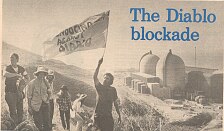




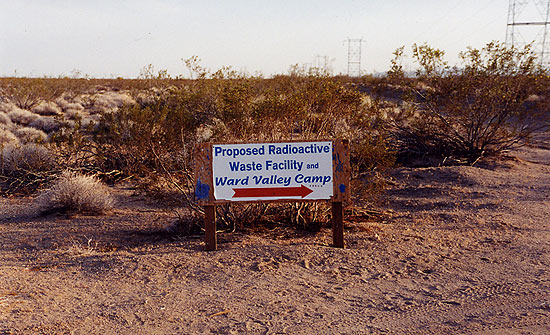 Over Twenty years after the sucessful battle to Stop Ward Valley, here is an updated
release of materials from the eight year struggle put together to cover the first five years
of what happened. Click on the above tabs to read the Part I stories listed below.
Over Twenty years after the sucessful battle to Stop Ward Valley, here is an updated
release of materials from the eight year struggle put together to cover the first five years
of what happened. Click on the above tabs to read the Part I stories listed below.