 The
Energy Net
The
Energy Net | The
Energy Net |
|
Under construction(9-22-08)
Nuclear
Facts
|
Uranium Mining BasicsFuel Cycle
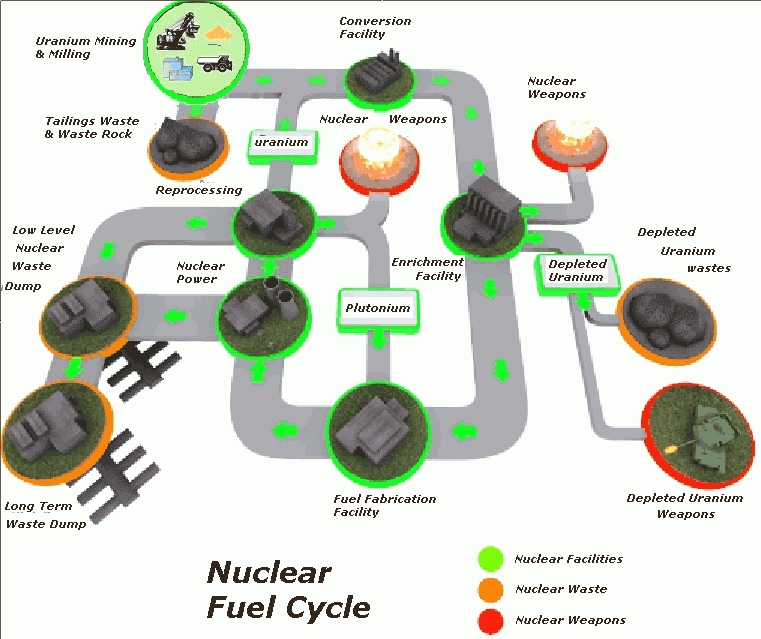
During the last 60 years the government has spent hundred's of bilions of dollars on this infrastructure. The fuel-cycle represents generations of government subsidies to for the commercial nuclear power industry. Go here for more on the Nuclear Fuel CycleUranium
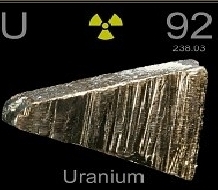
Uranium is a chemical element in the periodic table that has the symbol U and atomic number 92. Heavy, silvery-white, toxic, metallic, naturally radioactive, pyrophoric, and teratogenic uranium belongs to the actinide series and its isotope U-235 is used as the fuel for nuclear reactors and the explosive material for nuclear weapons. Depleted uranium is used in incendiary projectile weapons. Uranium is commonly found in very small amounts in rocks, soil, water, plants, and animals (including humans).
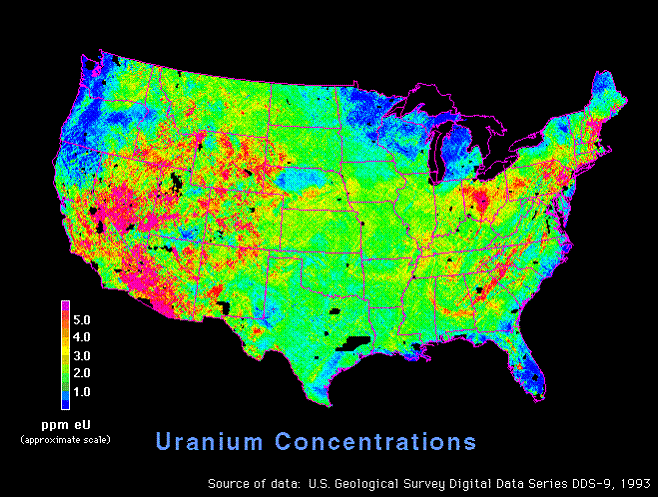
U.S. concentrations of uranium ore in the U.S. exist primarily in two areas of the country. In the Appalachians and in the Southwest, up through the Rocky Mountain range. Wikipedia: Uranium referenceExploration
Most mining claims are made using the 1872 Mining Act that allows mining companies to pay pennies to tear up the land and then abandon it, forcing the public to pay for the clean up. Many of the largest companies like Cameco or Rio Tinto are global conglomerates produce few local jobs, yet reap immense profits.
Mining
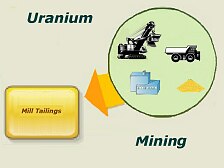
Uranium mining is done either by large strip mining operations or by an In-Situ Leach (ISL) process where chemicals are pumped into the ground, forcing a liquid slurry of uranium and other heavy metals up to the surface. Most current operations are strip mines, although there are a few hard rock underground mines still in operation. Most mines in the U.S. were shut down long ago due to the poor grade of uranium ore and uranium cheaper supplies from other global commercial operations or from the former soviet nuclear weapons infrastructure.
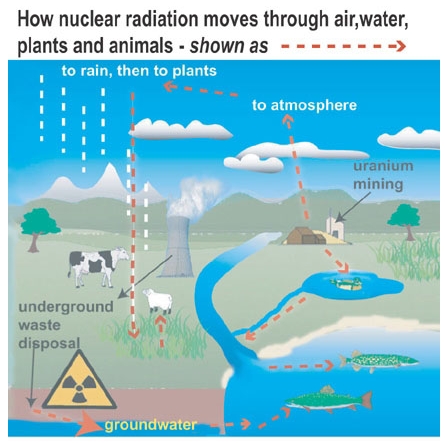
At present there are still thousands of abandoned uranium mines across the southwest that have yet to be cleaned up. Estimates of as much as $33 billion will be required to clean up the environmental disaster. The use of ISL mining is much cheaper than strip mining operations. However,it is extremely toxic to the underground aquifers. Claims that it will only be done on water supplies that will never be used for drinking are being clamed.
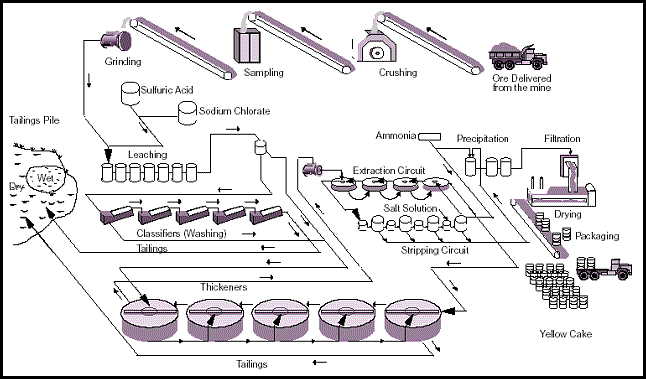
MillingOnce the raw uranium ore is extracted from the ground, it is then hauled via giant trucks to a uranium mill where the uranium yellowcake is extracted.
Tailings
Health
Resources
Uranium Mining PoliticsThe uranium mining industry in the U.S. collapsed completely with the end of the cold war. Speculators have driven the price of uranium up to nearly 10 times what it was worth prior to the Bush administration, creating a false appearance that uranium mining could once again be viable. It will only be a matter of time before the major international mining corporations like Rio Tinto or the French government sponsored Areva, Cameco or EDF move in and buy up the most lucrative options. The Bush Administration and the quasi private U.S. Energy Co. (USEC is the former DOE uranium enrichment infrastructure that was privatized during Clinton) are currently waging a legal battle to stop the use of Russian weapons grade uranium (MOX Fuel) to supply commercial reactors. If they win, there will be a huge new demand for uranium. Surprise! Another strategic motivation underlying Bush's reopening of a new cold war front with Russia! As detailed elsewhere, an extinct industry is being brought back to life, and done so under one of the most scandalous of histories. Until the Waxman hearings in October of 2007, all cleanup of the thousands of long abandoned uranium mines across the southwest had all but ceased under Bush. The EPA's job of coordinating the cleanup of Dineh AUM's ceased after a dispute over its refusal to hand over documents to the tribal government. After spending nearly $1.5 billion to clean up just 26 major contaminated sites by 1999 was projected to start work on another 100 cleanup projects, but has failed to do a single site under Bush. But what is probably the biggest scandal of all is what happened to the $8 Billion in federal money the private industry was given in 1988 that has all but dissappeared from sight. So, even though there are far high quality uranium mining operations in other parts of the world, fully capable of selling uranium to the U.S. commercial market, there are now thousands of new mining claims being staked, using the monsterous 1872 Mining Act that allows private speculators to lay claims to minerals on federal lands at a huge loss to the public.
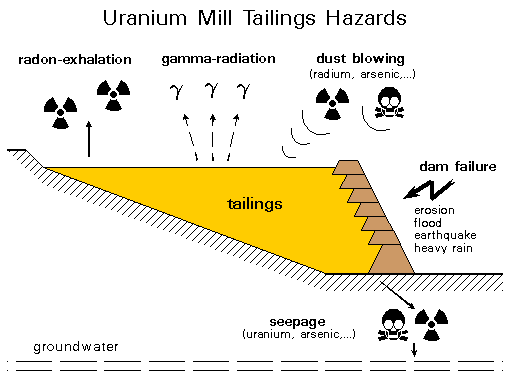
To the right are all the different waste streams of the nuclear fuel cycle. While to the left is an image of a uranium mill and the complex industrial process that takes place to separate concentrated uranium from the original ore. Health Impacts
Wyoming Tailings Impoundments 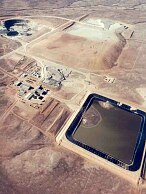 The
tailings impoundments shown on this page are located at the Swetwater
Uranium Project approximately forty-two (42) miles northwest of Rawlins,
Wyoming, UMETCO Minerals Corporation's Gas Hills Site near Riverton, Wyoming
and International Uranium (USA) Corporations's (IUC's) White Mesa Mill
near Blanding, Utah. SWEETWATER TAILINGS IMPOUNDMENT The tailings impoundment
shown in this aerial photograph to the right is the Sweetwater Uranium
Project tailings impoundment. The Sweetwater Mill is the only remaining
uranium mill in Wyoming. It is a sixty (60) acre Hypalon lined impoundment
designed to retain uranium mill tailings. The tailings impoundment is
the large, black pond in the lower right hand corner of the photograph. The
tailings impoundments shown on this page are located at the Swetwater
Uranium Project approximately forty-two (42) miles northwest of Rawlins,
Wyoming, UMETCO Minerals Corporation's Gas Hills Site near Riverton, Wyoming
and International Uranium (USA) Corporations's (IUC's) White Mesa Mill
near Blanding, Utah. SWEETWATER TAILINGS IMPOUNDMENT The tailings impoundment
shown in this aerial photograph to the right is the Sweetwater Uranium
Project tailings impoundment. The Sweetwater Mill is the only remaining
uranium mill in Wyoming. It is a sixty (60) acre Hypalon lined impoundment
designed to retain uranium mill tailings. The tailings impoundment is
the large, black pond in the lower right hand corner of the photograph.
Back to Uranium Mining Report |


 Uranium
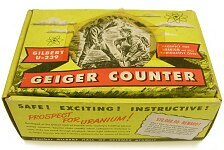
Ore must first be found before it can be mined. During the first
uranium rush during the 50's prospectors would find the uranium
using geiger counters. Today, the process is done by drilling bore
holes and then analysing the content. Due to the jump in uranium
prices in 2005 there has been a dramatic increase in uranium exploration
with over $700 million spent.
Uranium
Ore must first be found before it can be mined. During the first
uranium rush during the 50's prospectors would find the uranium
using geiger counters. Today, the process is done by drilling bore
holes and then analysing the content. Due to the jump in uranium
prices in 2005 there has been a dramatic increase in uranium exploration
with over $700 million spent.