The
Nuclear
Fuel Cycle is the massive nuclear weapons supply system, hidden
for generations by the
military industrial complex. It is broken into two main parts,
the front end, where uranium is mined and concentrated to make nuclear
weapons, and later for nuclear powered electricity. The back end
of the nuclear fuel cycle is all about nuclear waste and spent fuel
storage. Spent nuclear fuel is the most deadly material known, remaining
radioactive for hundreds of thousands of years. The nuclear fuel
cycle is one of the largest and most complex industrial processes
in the world. Called the Manhattan Project, it was secretly set
up to produce the nuclear bombs that were used on Hiroshima and
Nagasaki in 1945. Over 200,000 people died, with the lingering effects
being passed on to following generations in their genes. It is estimated
that the U.S. has spent $5 trillion during the atomic age. This
Faustian
bargain has altered the genetic future of all life on earth.
The
Atoms for
Peace campaign was a cold war tactic to develop nuclear technology
for civilian use to rationalize the expense of the massive industrial
complex that is now managed by the Department
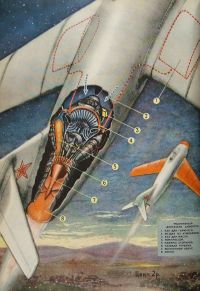
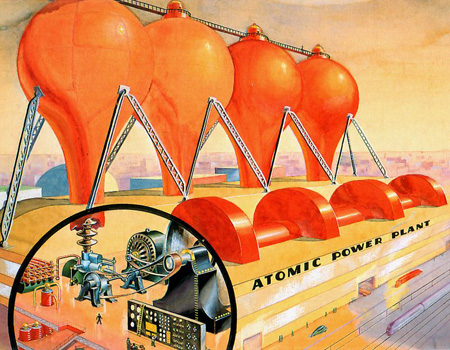
of Energy(DOE). The media promoted claims that we would be flying
in nuclear planes, promising that nuclear electricity would be too
cheap to meter. The DOE spends $25 billion a year to manage over
30 national laboratories with 90% of all work contracted
out to giant corporations like Battelle,
CH2M Hill,
Fluor Daniel,
Lockheed,SAIC,
and Bechtel.
Between 100,000 and 400,000 former DOE employees were adversely
affected by working in the nuclear industry. Massive contamination
scandals racked the DOE in the late 80,'s.
Cleanup
costs were estimated to exceed $100 billion. The Bush Administration
is pushing to spend hundreds of billions more to completely revitalize
the entire nuclear weapons complex. Over 1/2 million military personnel
witnessed close up atmospheric tests. Citizens in prison as well
as mentally handicapped were purposely exposed to excessive radiation
experiments without their consent or knowledge. The atmospheric
tests done in Nevada and elsewhere between 1948 and 1963 affected
the lives and health of millions of Americans across the country.
Compensation programs for workers, miners and downwinders have spent
billions of dollars but as of yet begun to deal with the scale of
the impacts. The National Institute of Health released the first
comprehensive investigation of the radioactive fallout. This is
our online Department of Energy page.
Mining
Uranium Mining
The
first step in the nuclear fuel cycle is the mining and milling process.
Historically, uranium was found using Geiger counters. Today it
is done by airborne gamma-ray spectrometry. An area is then selected
using a variety of criteria for mining. The best sources within
the U.S. are located in the Southwest on indigenous lands.
Even
though the dangers were known by experts hard rock mining techniques
of extracting uranium was offered as a labor source for tribes like
the Navajo. Many of the miners would later die of cancer, passing
congenital disease onto their children.
As demand grew for uranium large companies like the French owned
Cameco would use modern excavation and In Situ Leech (ISL)to recover
uranium ore. Excavation may be underground or via open pit mining.
Open
pit mines require large holes on the surface. The milling process
extracts the uranium from the original ore leaving behind large
dry or wet tailings. An growing percentage of uranium now comes
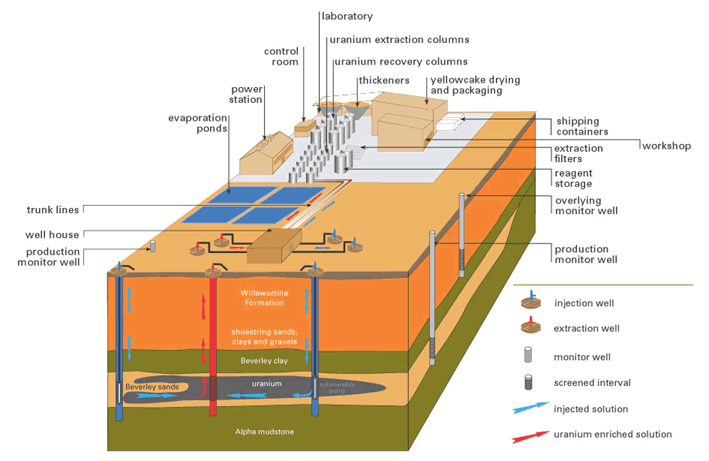
from In Situ Leaching (ISL), where oxygenated groundwater is circulated
through a very porous orebody to dissolve the uranium and bring
it to the surface in a water based slurry. Acids or alkaline chemicals
are used to keep the uranium in solution. The uranium is then recovered
from the solution in a conventional mill.
The
quarried raw ore from open pit mines is then hauled via giant trucks
to a uranium mill. The milling process crushes the ore into a fine
sandy powder that is then mixed with large amounts of water, acids
and other chemicals to tease out the uranium. It is dried and dyed
yellow whiich is how it gets the name yellowcake.
Left
behind are immense dry or wet tailing piles of the original ore
that contain 80% of the original radiation, and other environmentally
sensitive materials. The U.S. industry collapsed by 1990 leaving
behind thousands of abandoned uranium mines mostly in the four corners
area of the southwest. These mines and the tailings piles have adversely
affected the environment and the health of the communities living
near them which happen to be mostly Navaho Indians.
The
awareness that these tailing piles represent a serious environmental
hazzard has been known since the 1970's. 300,000 tons of the radioactive
tailings were used to build the streets and foundations for homes
and office buildings in Grand Junction Colorado. The government
was forced to spend nearly a billion dollars to fix this mess in
a white community. Previous attempts to cleanup thousands of abandoned
mines on Navajo lands failed. Not until 2007 did the abandoned mines
get readdressed. Homes were built with contaminated materials. Their
drinking water is contaminated resulting in devastating health impacts.
Then there is the story about the previos generation of Navajo uranium
miners who died from Radon poisoning.
In
1979, A tailings site at Churchrock New Mexico broke free of its
dam and contaminated indigenous communities drinking water. Today,
another major tailings dam at Moab Utah is endangering the Colorado
River and water supplies of much of the southwest U.S.. Cleanup
costs at the Moab site is estimated to cost $1 billion and not be
completed until 2020. Cleanup costs for the entire nightmare range
as high as $30 billion. And yet, there is now a new push to starting
mining across the same areas that have yet to be cleaned up. Nearly
a thousand mining claims have been placed within 5 miles of the
Grand Canyon, with thousands more across the region.
After
the uranium milled into yellowcake, it must go through a series
of complex steps before it can be used as nuclear fuel. It is first
turned into a gas (uranium dioxide) and then into uranium hexafluoride
(UF6) at the country's only conversion
facility located in Metropolis Illinois. Converdyn
operates the conversion facility and is a joint partnership between
General Atomics
and Honeywell.
It currently has the capacity to produce up to 15,000 tons of UF6
a year. There was a December 2003 fire at the 1,100 acre facility
that required public evacuation of the nearby area. Eleven workers
were contaminated by a UF6 leak. Federal funding was required starting
in 2000 to keep the facility from going bankrupt due to the lack
of business.
The
Converdyn facility is located on the Ohio River, across from the
massive Paducah Gaseous diffusion facility where the UF6 then goes
for enrichment.
To the left is a close-up of the UF6 Conversion facility yard where
old canisters are being stored. Newer canisters can be seen in detail
with the Enrichment section.
Enrichment
U.S. Enrichment Facilities
The
uranium hexafluoride (UF6) then travels across the river to be enriched
at the Gaseous Diffusion facility at Paducah Kentucky. The U.S.
currently uses a now outmoded enrichment process called gaseous
diffusion to concentrate uranium enough to reach critical mass.
The uranium must be enriched from 1% to between 3-5% for commercial
reactors or to more than 85% for weapons grade material.
The
first gaseous diffusion facility in Oak Ridge Tennessee called the
K-25 facility was the largest manufacturing building ever built
and was a mile long. At the peak of operation there were three facilities
operating, including Paducah Kentucky and Portmouth Ohio. These
units used vast amounts of water and 3% of the entire electrical
output of the U.S. The K-25 facility was shutdown in 1987 and is
still awaiting decommissioning. The Portsmouth Ohio Gaseous Diffusion
facility ran from 1954 to 1991, but still is in operation for other
work.
These
facilities are also where a large percentage of the tens of thousands
of U.S. workers were contaminated, right up to the present time,
with over 100,000 workers currently requesting compensation for
their illnesses.
In 1997 congress transferred the entire infrastructure to a quasi
private company called the U.S.Enrichment Corporation. The gaseous
diffusion enrichment process is considered an outdated technology
with the goal of replacing it with gaseous centrifuges.
One of the byproducts of enrichment process is depleted uranium.
As part of the cold war exchange, the U.S. starting experimenting
with the recycling of depleted uranium for the development of armor
piercing ammunition in the 1970's.
Fuel Fabrication
The
enriched uranium is then converted into a solid uranium dioxide
(UO2) powder and pressed into small pellets. The pellets are placed
into fuel rods that are about 4 meters long. These fuel rods are
coated with a zirconium alloy to protect them from extreme heat
and then put into assemblies for use in nuclear power stations.
The U.S. currently has two types of reactors the Boiling Water Reactor
(a BWR assembly hold 63 fuel rods) or the Pressurized Water Reactor
(the PWR assembly holds 265 rods).Large amounts of fluorine and
chlorine are used in making uranium fuel.
The nuclear industry likes to brag about how much energy it gets
from a single uranium pellet. Imagine all the work done by that
one uranium pellet could never exist if it wasn't for the largest,
most expensive and complex industrial infrastructure in the world!
It is one of the largest users of water and energy in the world.
In 2006 U.S. commercial reactors purchased 33,000 tons of uranium
fuel. And for you energy independence buffs, none of it was mined
from within the U.S.
For every ton of uranium fuel used, about 55 tons of radioactive
waste tailings are produced, or over 1.8 million tons a year, or
over 120 million cubic meters to date.
The EPA estimates that there are somewhere between 1-9 billion
tons of abandoned uranium tailings are left at approximately 4,000
abandoned uranium mines. Four billions tons of tailings would fill
26,000 football fields 8 stories high with wastes.
The Rossing mine (one of the largest in the world) extracted over
19 million tons or raw ore to produce 3,700 tons of uranium ore
in 2005. It used 3.3 million cubic meters of water and 225,000 tons
of acid to produce the yellowcake. The tailings pond at Rossing
is over 730 Hectares over over 1,500 acres in size, while the facility
itself covers 23 square kilometers. It uses nearly 30% of the entire
water consumption of Nambia. There are currently 8 mines in Canada
that are each over 4,000 acres in size. There are two gigantic mines
in Australia (Ranger and Olympic) that are producing nearly 9,000
tons of uranium yellowcake a year.
And we haven't begun to talk about the spent fuel, as well as low-level
wastes produced by nuclear industry. Or the fact that a single nuclear
reactor uses about 1 billion gallons of water for cooling every
day. Or the immense amounts of water and energy the gaseous diffusion
facilities during the enrichment phase use. According
to one study, the Energy Return on Investment (EROI) is less
that 1 to 5 compared with 1 to 40 for oil.
Reactors
The
U.S. currently has commercial 104 nuclear power reactors operating.
They are regulated by the federal Nuclear Regulatory Commission.
No state or local oversight of nuclear power plants is allowed except
for the rates charged to the public for electricity. Each reactor
consumes about 150 tons of uranium fuel per year. The uranium fuel
pellets are placed in long zirconium rods that are then placed in
assembles inside the nuclear reactor.
A
large 1,000 megawatt reactor uses up to 1 billion gallons of water
per day for cooling. In the case of the Diablo Canyon facility (right)
state and federal environmental laws were waived to allow for operation.
The largest population of Abalone in North America was destroyed
the first day the reactor's plumbing was tested. The two Diablo
Canyon initially had a $54 billion contract to operate for its first
30 years. Reactors cost $5.8 billion to construct and over $7 billion
in financing. The U.S. EPA loaned the utility over $2 billion to
complete the reactors It is located 2 miles from the fault that
leveled the city of Santa Barbara in 1927.
Over $3 billion of ratepayer money has been placed in a special
federal account to pay for the reactor's decommissioning when finally
shut down. In the late 1990's one of the largest proposed fines
ever for lying to federal authorities about contamination of the
offshore environment magically disappeared. -
Typically a 1000 MWe reactor will discharge about 2 metric tons
of high level waste each refueling. This is a work in progress(Oct
5th, 2008)
Spent Fuel
Approximately
every 18 months a commercial reactor is shut down for a month to
remove spent nuclear fuel and add new fuel. The spent fuel assemblies
are placed in an adjacent spent fuel pond. The spent fuel ponds
at reactors across the U.S. are nearly full today. Thirty years
ago the DOE promised that it would have a spent fuel repository
available by 1998. Sorry, but due to the undemocratic process of
shoving the repository down the throat of the state of Nevada, it
has fought back. Proving that the plans to store the most deadly
waste in the world at Yucca Mountain is scientifically problematic
at best.
The Yucca Mt. spent fuel disposal site is estimated to cost
$100 billion dollars and will dispose of roughly half of America's
spent fuel. The cost of sending a man to the moon was $100 billion
dollars. In June of 2008 Senator Lieberman attempted to sneak in
a $518 billion check to the nuclear industry to build 45 reactors.
President Bush's Global Nuclear Energy partnership, where nuclear
fuel would be reprocessed using breeder reactors to make plutonium
was estimated to cost over $400 billion.
 The
Energy Net
The
Energy Net 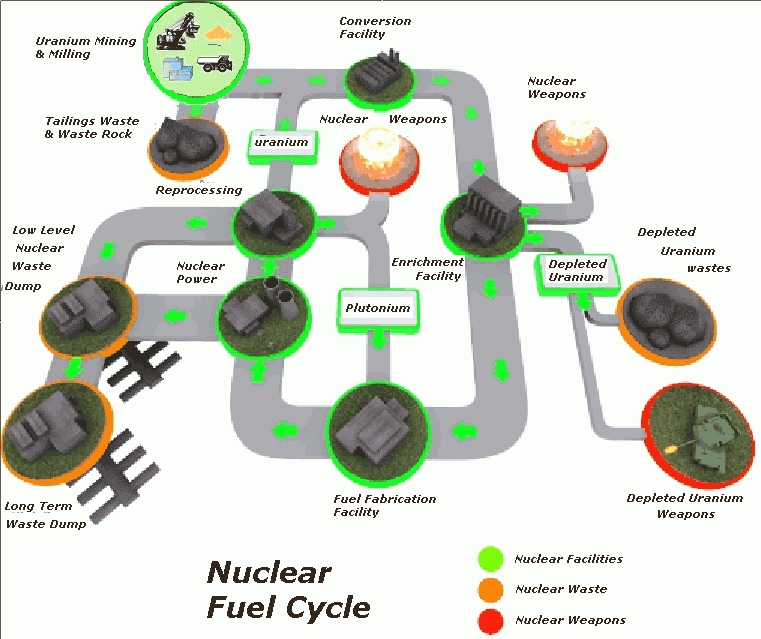

 The
first step in the nuclear fuel cycle is the mining and milling process.
Historically, uranium was found using Geiger counters. Today it
is done by airborne gamma-ray spectrometry. An area is then selected
using a variety of criteria for mining. The best sources within
the U.S. are located in the Southwest on indigenous lands.
The
first step in the nuclear fuel cycle is the mining and milling process.
Historically, uranium was found using Geiger counters. Today it
is done by airborne gamma-ray spectrometry. An area is then selected
using a variety of criteria for mining. The best sources within
the U.S. are located in the Southwest on indigenous lands. 


 The
awareness that these tailing piles represent a serious environmental
hazzard has been known since the 1970's. 300,000 tons of the radioactive
tailings were used to build the streets and foundations for homes
and office buildings in Grand Junction Colorado. The government
was forced to spend nearly a billion dollars to fix this mess in
a white community. Previous attempts to cleanup thousands of abandoned
mines on Navajo lands failed. Not until 2007 did the abandoned mines
get readdressed. Homes were built with contaminated materials. Their
drinking water is contaminated resulting in devastating health impacts.
Then there is the story about the previos generation of Navajo uranium
miners who died from Radon poisoning.
The
awareness that these tailing piles represent a serious environmental
hazzard has been known since the 1970's. 300,000 tons of the radioactive
tailings were used to build the streets and foundations for homes
and office buildings in Grand Junction Colorado. The government
was forced to spend nearly a billion dollars to fix this mess in
a white community. Previous attempts to cleanup thousands of abandoned
mines on Navajo lands failed. Not until 2007 did the abandoned mines
get readdressed. Homes were built with contaminated materials. Their
drinking water is contaminated resulting in devastating health impacts.
Then there is the story about the previos generation of Navajo uranium
miners who died from Radon poisoning. In
1979, A tailings site at Churchrock New Mexico broke free of its
dam and contaminated indigenous communities drinking water. Today,
another major tailings dam at Moab Utah is endangering the Colorado
River and water supplies of much of the southwest U.S.. Cleanup
costs at the Moab site is estimated to cost $1 billion and not be
completed until 2020. Cleanup costs for the entire nightmare range
as high as $30 billion. And yet, there is now a new push to starting
mining across the same areas that have yet to be cleaned up. Nearly
a thousand mining claims have been placed within 5 miles of the
Grand Canyon, with thousands more across the region.
In
1979, A tailings site at Churchrock New Mexico broke free of its
dam and contaminated indigenous communities drinking water. Today,
another major tailings dam at Moab Utah is endangering the Colorado
River and water supplies of much of the southwest U.S.. Cleanup
costs at the Moab site is estimated to cost $1 billion and not be
completed until 2020. Cleanup costs for the entire nightmare range
as high as $30 billion. And yet, there is now a new push to starting
mining across the same areas that have yet to be cleaned up. Nearly
a thousand mining claims have been placed within 5 miles of the
Grand Canyon, with thousands more across the region. 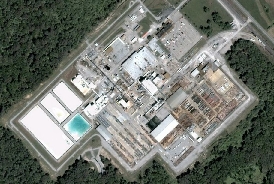 After
the uranium milled into yellowcake, it must go through a series
of complex steps before it can be used as nuclear fuel. It is first
turned into a gas (uranium dioxide) and then into uranium hexafluoride
(UF6) at the country's only
After
the uranium milled into yellowcake, it must go through a series
of complex steps before it can be used as nuclear fuel. It is first
turned into a gas (uranium dioxide) and then into uranium hexafluoride
(UF6) at the country's only 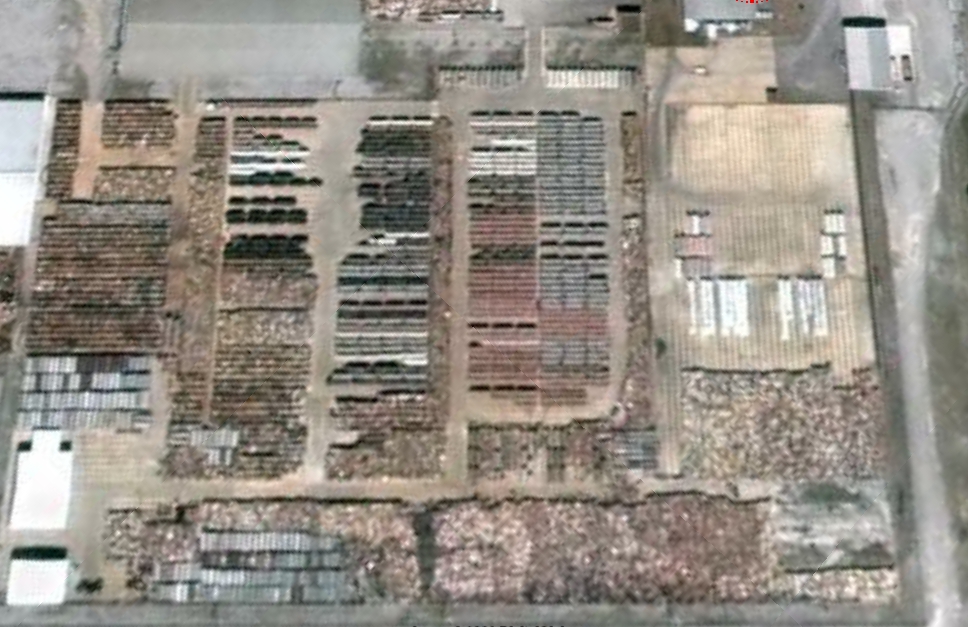
 The
uranium hexafluoride (UF6) then travels across the river to be enriched
at the Gaseous Diffusion facility at Paducah Kentucky. The U.S.
currently uses a now outmoded enrichment process called gaseous
diffusion to concentrate uranium enough to reach critical mass.
The uranium must be enriched from 1% to between 3-5% for commercial
reactors or to more than 85% for weapons grade material.
The
uranium hexafluoride (UF6) then travels across the river to be enriched
at the Gaseous Diffusion facility at Paducah Kentucky. The U.S.
currently uses a now outmoded enrichment process called gaseous
diffusion to concentrate uranium enough to reach critical mass.
The uranium must be enriched from 1% to between 3-5% for commercial
reactors or to more than 85% for weapons grade material.  The
first gaseous diffusion facility in Oak Ridge Tennessee called the
K-25 facility was the largest manufacturing building ever built
and was a mile long. At the peak of operation there were three facilities
operating, including Paducah Kentucky and Portmouth Ohio. These
units used vast amounts of water and 3% of the entire electrical
output of the U.S. The K-25 facility was shutdown in 1987 and is
still awaiting decommissioning. The Portsmouth Ohio Gaseous Diffusion
facility ran from 1954 to 1991, but still is in operation for other
work.
The
first gaseous diffusion facility in Oak Ridge Tennessee called the
K-25 facility was the largest manufacturing building ever built
and was a mile long. At the peak of operation there were three facilities
operating, including Paducah Kentucky and Portmouth Ohio. These
units used vast amounts of water and 3% of the entire electrical
output of the U.S. The K-25 facility was shutdown in 1987 and is
still awaiting decommissioning. The Portsmouth Ohio Gaseous Diffusion
facility ran from 1954 to 1991, but still is in operation for other
work. These
facilities are also where a large percentage of the tens of thousands
of U.S. workers were contaminated, right up to the present time,
with over 100,000 workers currently requesting compensation for
their illnesses.
These
facilities are also where a large percentage of the tens of thousands
of U.S. workers were contaminated, right up to the present time,
with over 100,000 workers currently requesting compensation for
their illnesses.  The
enriched uranium is then converted into a solid uranium dioxide
(UO2) powder and pressed into small pellets. The pellets are placed
into fuel rods that are about 4 meters long. These fuel rods are
coated with a zirconium alloy to protect them from extreme heat
and then put into assemblies for use in nuclear power stations.
The U.S. currently has two types of reactors the Boiling Water Reactor
(a BWR assembly hold 63 fuel rods) or the Pressurized Water Reactor
(the PWR assembly holds 265 rods).Large amounts of fluorine and
chlorine are used in making uranium fuel.
The
enriched uranium is then converted into a solid uranium dioxide
(UO2) powder and pressed into small pellets. The pellets are placed
into fuel rods that are about 4 meters long. These fuel rods are
coated with a zirconium alloy to protect them from extreme heat
and then put into assemblies for use in nuclear power stations.
The U.S. currently has two types of reactors the Boiling Water Reactor
(a BWR assembly hold 63 fuel rods) or the Pressurized Water Reactor
(the PWR assembly holds 265 rods).Large amounts of fluorine and
chlorine are used in making uranium fuel. 

 A
large 1,000 megawatt reactor uses up to 1 billion gallons of water
per day for cooling. In the case of the Diablo Canyon facility (right)
state and federal environmental laws were waived to allow for operation.
The largest population of Abalone in North America was destroyed
the first day the reactor's plumbing was tested. The two Diablo
Canyon initially had a $54 billion contract to operate for its first
30 years. Reactors cost $5.8 billion to construct and over $7 billion
in financing. The U.S. EPA loaned the utility over $2 billion to
complete the reactors It is located 2 miles from the fault that
leveled the city of Santa Barbara in 1927.
A
large 1,000 megawatt reactor uses up to 1 billion gallons of water
per day for cooling. In the case of the Diablo Canyon facility (right)
state and federal environmental laws were waived to allow for operation.
The largest population of Abalone in North America was destroyed
the first day the reactor's plumbing was tested. The two Diablo
Canyon initially had a $54 billion contract to operate for its first
30 years. Reactors cost $5.8 billion to construct and over $7 billion
in financing. The U.S. EPA loaned the utility over $2 billion to
complete the reactors It is located 2 miles from the fault that
leveled the city of Santa Barbara in 1927. 