|
|
The
Abalone Alliance Story
 The
Abalone Alliance was started in May of 1977 when over 70 activists came
together to setup the statewide Alliance. Within a year, the group had
consensed on the wording of a Declaration of Nuclear Resistance. Its first
action at Diablo Canyon took place on August 6th 1977 where 47 people
were arrested at the gates. The following year, the number of those arrested
jumped to 487 people. The
Abalone Alliance was started in May of 1977 when over 70 activists came
together to setup the statewide Alliance. Within a year, the group had
consensed on the wording of a Declaration of Nuclear Resistance. Its first
action at Diablo Canyon took place on August 6th 1977 where 47 people
were arrested at the gates. The following year, the number of those arrested
jumped to 487 people.
The local affiliate of the Abalone Alliance was preparing to hold anti-nuclear
rally in early April of 1979 when the Three Mile Island meltdown took
place the just over a week before hand. Over 25,000 people showed up for
the rally in San Francisco, helping to set off a huge response that culminated
in the June 29th rally at SLO where nearly 50,000 people attended a rally
and concert with then Governor Jerry Brown coming out publicly against
nuclear power. Many AA activists were highly opposed to Brown's "Grandstanding"
at the rally.
The Alliance made a strategic decision not to hold another action at
Diablo Canyon until the NRC granted PG&E a license, which hurt the
movement energy. But even so, after the NRC illegally gave PG&E a
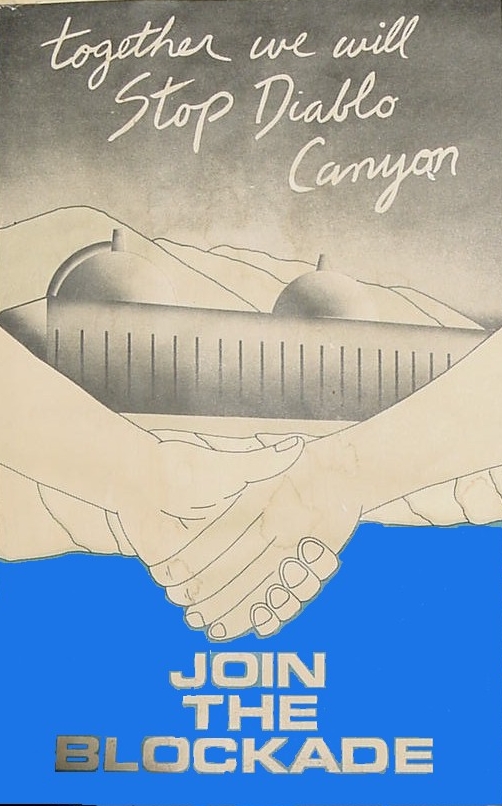
license, the Alliance held what is to this day the largest act of civil
disobedience in US history where nearly 1,900 arrests took place over
a 20 day blockade at Diablo Canyon. Just as the blockade was coming to
an end, a newly hired 25 year old engineer discovered that PG&E had
built the seismic supports for the reactors backwards, resulting in a
huge national scandal, that forced the NRC to pull the operating licenses.
Well over 10,000 people showed up in support of the September 10 1981
blockade. A year after the action the Pacific Legal Foundation and SLO
County filed legal suit against the AA in an attempt to get its membership
list to force them to pay for the police costs of the blockade. The SLAPP
suit would go for nearly 5 years, all the way up to the US Supreme court
before settling.
 After
the large blockade, the huge contingent from the SF Bay Area shifted its
attention to the Livermore Labs where a new group called the Livermore
Action Group started doing regular actions for a number of years. The
AA also helped put on a major Hall of Shame tour, going through the financial
district of San Francisco documenting the nuclear connections of large
corporations that had offices. AA also played a key roll in organizing
nuclear weapons related actions at Vandenberg Air Force Base. Then in
1984, after President Reagan had secretly given PG&E over $2 billion
to help rebuild Diablo for the 3rd time AA activists carried out months
of smaller actions called the People's Emergency Response Plan at the
gates of Diablo Canyon where hundreds of activists were arrested but ignored
by the media. Even a ratestrike campaign was initiated but was blocked
by the PUC. During this time, the put out its own semi-monthly newspaper
called It's About Times that covered nuclear news from around the world.
During actions the Alliance also put out Handbooks that were used educate
as well as prepare activists for what would be in store. The 1981 Blockade
handbook was nearly 100 pages long for example. After
the large blockade, the huge contingent from the SF Bay Area shifted its
attention to the Livermore Labs where a new group called the Livermore
Action Group started doing regular actions for a number of years. The
AA also helped put on a major Hall of Shame tour, going through the financial
district of San Francisco documenting the nuclear connections of large
corporations that had offices. AA also played a key roll in organizing
nuclear weapons related actions at Vandenberg Air Force Base. Then in
1984, after President Reagan had secretly given PG&E over $2 billion
to help rebuild Diablo for the 3rd time AA activists carried out months
of smaller actions called the People's Emergency Response Plan at the
gates of Diablo Canyon where hundreds of activists were arrested but ignored
by the media. Even a ratestrike campaign was initiated but was blocked
by the PUC. During this time, the put out its own semi-monthly newspaper
called It's About Times that covered nuclear news from around the world.
During actions the Alliance also put out Handbooks that were used educate
as well as prepare activists for what would be in store. The 1981 Blockade
handbook was nearly 100 pages long for example.
In August the NRC again gave PG&E a license to start operation. In
late November one of the NRC commissioners leaked the transcripts documenting,
giving opponents the legal proof that the reactors had been illegally
licensed, setting off a major struggle between the Mothers for Peace and
the courts that went through 1986. After the courts ruled in favor of
PG&E/NRC to let the reactors go hot, the AA closed most of its offices
across the state. The AA statewide office in SF was held open until 1989
as a small number of local groups still continued to pay dues. The SF
office also became an intervenor during the nearly 4 year long CPUC hearings
over how much the public should pay, as well as taking a modest role in
the post Chernobyl events that included the campaign to close Rancho Seco.
The last activist project of the office took place in 1990 when California
pushed to open a nuclear waste dump at Ward Valley, near Needles. The
city office played a key role in helping gain the critical early delays
that helped keep Governor Dukumejian from licensing and opening the dump
on land deemed sacred to 6 tribes.
During the AA hey days, the Alliance had affiliates in nearly every major
city in California with over 60 member groups, that included the huge
Alliance for Survival in Los Angeles and San Diego. Greenpeace was also
a member of the Alliance and took an active part in the 1981 blockade.
Thanks to its sister bivalve group the Clamshell Alliance, Quakers and
especially young quakers who were part of the Movement for a New Society
played a major roll in pushing the Alliance to adopt a non-violent, feminist
process called Consensus process that included extensive non-violent trainings
for all people wanting to take part. The key roll of a non-hierarchical,
non Robert Rules of Order process was almost unknown within the progressive
movement until the Clamshell then the AA helped to promote the ideas of
consensus, non-violence, and Affinity groups. The corporate media all
but trashed the AA and its actions, ignoring its broad support within
the local SLO community at the time. The Alliance went to help finance
a documentary of the 1981 blockade that took five years to complete called
a Question of Power that laid out the Issues at Diablo and why the AA
chose to act the way it did.
After the Three Mile Island and the dramatic upswing in interest of the
Alliance, activists spent nearly a year investigating and modifying consensus
process to deal with the complexities of dealing with large numbers of
people spread over a very large area. Individuals would not be allowed
to block at the state level, requiring that only groups had that ability.
During this time, it became ever more clear that it would be very difficult
to carry out a a pure form of consensus based decision process when it
meant that groups large and small had to routinely travel long distances
to get to statewide meetings.
- August
6, 1977 The Abalone Alliance holds its first blockade at Diablo
Canyon; 47 people arrested while 1,500 people show support at a nearby
rally.
- August
6, 1978 487 people arrested at the gates of Diablo Canyon, while
5,000 people attend a support rally.
- March
28, 1979 The Three Mile Island (TMI) accident spurs nationwide concern
over nuclear power's safety.
- April
7, 1979 A San Francisco rally sponsored by the Alliance's local
group draws 25,000 people.
- June
28, 1979 A statewide rally draws 40,000 people to San Luis Obispo.
Governor Jerry Brown publicly comes out against Diablo Canyon at that
rally.
- Thanksgiving
1979 Alliance members hold a 38-day sit-in at Governor Brown's office
to protest continued operation of the Rancho Seco reactor, a TMI twin.
- June
1979 to September 1981 The Alliance organizes neighborhood outreach
campaigns and educational workshops across California, while also preparing
for a major blockade at Diablo Canyon in case the NRC approves the reactor's
operating license.
- September
10, 1981 The Alliance begins a two week blockade of Diablo Canyon
during which 1,960 people are arrested. The last day of the action,
it is reported that part of the reactor had been installed backwards.
The NRC revokes PG +E's operating license in embarrassment.
- October
1981 The Pacific Legal Foundation, part of a nationwide network
of right wing legal organizations challenging the First Amendment, brings
a $1 million lawsuit against the Alliance, hoping to prevent further
Alliance actions. The suit takes 5 years to complete (see October, 1986).
- 1982-1984
While public concern shifts toward nuclear weapons, Alliance activities
shift toward hearings being held concerning who will pay for Diablo
Canyon.
- January
13, 1984 After the NRC announces that it will license Diablo Canyon,
the Alliance mobilizes the People's Emergency Response Plan, which lasts
through April and results in over 500 arrests involving actions at the
main gate, in the back country and at PG+E headquarters in San Luis
Obispo.
- June
1984 AA participates in writing the energy plank of the People's
Congress platform presented to the 1984 National Democratic Convention
in SF by Jesse Jackson.
- June
1984 A ratestrike campaign is launched by the Abalone Alliance that
is timed to start upon start up of Diablo Canyon.
- July
1984 AA helps plan large teach-in and civil disobedience of the
patriarchy at Bohemian Grove. 50 are arrested.
- August
12, 1984 One week after the NRC grants a full-power operating license
for unit 1, a protest is held at Diablo Canyon. At the same time, Mothers
for Peace gains an injunction against the reactor's operation until
November.
- September
1984 to April 1986 The Alliance shifts gears as the federal government
breaks its own laws to license Diablo Canyon. With Diablo operating
and PG+E's announcement that no more reactors will be built nuclear
power subsides as a critical issue in California. It's About Times,
the Alliance's newspaper is closed and elimination of salaries for staff
at the two state-wide offices end. Volunteer staff continue operating
the Alliance statewide office as a clearinghouse for nuclear power and
alternatives. November 1985 The Alliance and dozens of other groups
get involved in the massive Diablo Canyon Rate Case to decide who will
pay for the reactor's construction costs.
- April
25, 1986 The last legal attempts to force seismic hearings on Diablo
Canyon fail due to the decision of Federal District Court Judge, Robert
Bork.
- April
26, 1986 Chernobyl reactor in the Soviet Union blows its containment
vessel, bringing about the most serious accident in industrial history.
Information begins to spread about a serious accident potential at Rancho
Seco.
- August
10-11 1986 Alliance groups hold a rally, teach-in and civil disobedience
in Sacramento to protest the reopening of the Rancho Seco reactor. Twenty-one
people are arrested.
- September
1986 to December 1986 Nuclear Free California, an Abalone group,
starts a statewide petition drive to pressure lawmakers into phasing
out nuclear power in California. Another affiliate, the Redwood Alliance
and the state-wide office actively participate in Diablo Canyon's decommissioning/rate
hearings before the PUC.
- October
21, 1986 The 5-year lawsuit by the Pacific Legal Foundation goes
all the way to the U.S. Supreme court before being settled in favor
of the Alliance.
- April
26-27, 1987 400 people march to the gates of Diablo Canyon in conjunction
with 40 other groups across the U.S. to commemorate the 1st anniversary
of Chernobyl. 15 people are arrested for stepping across a blue line
into PG+E property.
- October
13, 1987 The judge in charge of the case prosecuting the people
involved in the 1981 blockade of Diablo Canyon finally issues his decision
granting defendants the right to use the rarely allowed "Defense of
Necessity". The state immediately drops charges against all arrested
rather than allow our expert witnesses the the chance to legally present
the technical flaws at Diablo Canyon and the specific dangers of operating
a nuclear facility on an active fault line as the primary reason for
being arrested.
- January
1988 The State-wide office discovers that 90% of the East-Bay's
drinking water is in the evacuation zone of Rancho Seco. A two step
campaign is set in motion to notify East-Bay cities of this, forcing
local emergency planners to notify the public of this danger as required
by law.
- June
7, 1988 Sacramento citizens fail to close Rancho Seco by popular
referendum. The measure loses by less than 2% of the vote.
- June
27, 1988 In a dramatic reversal in the Diablo Rate Case, the PUC
proposes a settlement scuttling an 80% disallowance proposed by their
own staff for PG+E's disasterous construction of Diablo Canyon.
- December
19, 1988 The PUC decides in favor of giving PG+E California's first
ever free market contract to a utility for Diablo Canyon. This is done
over opposition by the Alliance and other concerned groups. If the reactors
can be made to operate for 30 years, they will drive utility rates sky
high, while giving PG+E $47 to $53 billion in ratepayers' money.
- January
28, 1989 AA begins working with the national Greens on creating
a green energy policy platform and creation of a computerized Green
energy network.
- June
8, 1989 Rancho Seco is finally closed by popular vote. The first
nuclear power facility in U.S. history to be shut down due to a popular
vote.
- August
1990 The Alliance sets off statewide alert opposing plans to build
a nuclear waste dump at Ward Valley near Needles Ca.
- November
17, 1990 Individuals representing California groups form Don't
Waste California to work on nuclear issues such as the Needles dump
and the NRC attempt to deregulate nuclear waste (BRC).
- April
1991 Don't Waste California initiates organized opposition to Ward
Valley in southern California. AA staff also helped coordinate People's
Earth Day in Bay View Hunter's Point;
- June
1991 Statewide coalition succeeds at getting the State Lands Commission
to block the transfer of land at Ward Valley from federal to state hands,
stopping the planned construction of the nuclear waste dump.
- July
1991 The statewide coalition turns out hundreds of protesters at
each of 3 public Ward Valley Dump hearings held around the state.
- January-October
1992 Organizers sponsor and win passage of three laws that would
have dramatic impact on the Ward Valley Dump. Governor Wilson vetoes
all 3 bills.
- December
1992 A last ditch attempt to force the land transfer to state hands
by the Bush Administration is blocked.
- January
1993 Presidenta Clinton's Secretary of the Interior Bruce Babbitt
agrees to review the the Ward Valley issue.
- February
1993 An electronic Bulletin Board Service is opened as a public
resouce for safe energy documents.
- Spring
1993 Organizers suceed at blocking key appointment to the California
Department of Health Services until Governor Wilson agrees to hold hearings.
One of the largest producers of Tritium wastes leaves the state while
the other one agrees to start re-using the tritium rather than throwing
it out.
- Spring
1993 - Spring 1995 Legal battles on several fronts are waged to
block the proposed nuclear waste dump. Spring 1995 - Governor Wilson
goes ahead and grants U.S. Ecology a license to operate Ward Valley.
Appeals are filed.
- May
1995 Republicans push for legislation to force the land transfer
and bypass our blocks on Ward Valley.
- October
1995 Statewide coalition holds rally at Ward Valley to protest
the continue push to construct and open the nuclear waste dump.
|
 The
Energy Net
The
Energy Net